


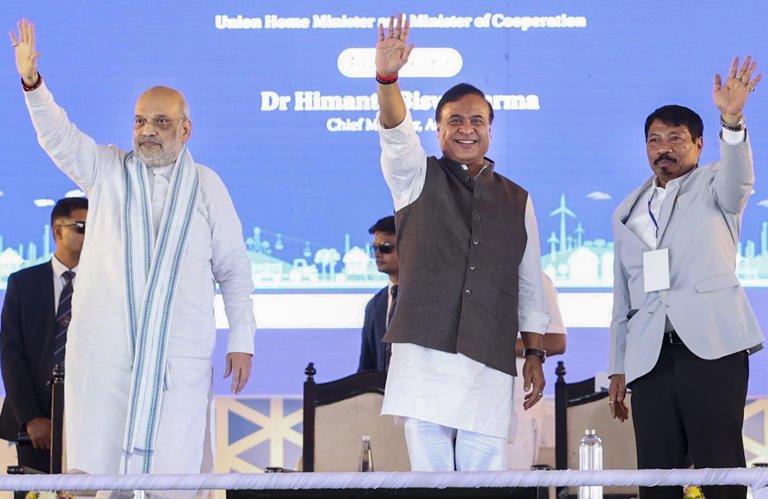
Union Home Minister Amit Shah launched the second phase of the border village programme during a major event in Assam, placing strong emphasis on development and national security along India’s frontier regions. The announcement quickly drew political attention after Shah accused the Congress of allowing infiltration during its years in power. However, he insisted that the border village programme aims to transform remote settlements into vibrant centres of growth while strengthening strategic preparedness.
Speaking at the launch, Shah said border villages should be seen as the country’s “first villages” rather than distant outposts. According to him, residents living near international boundaries play a crucial role in safeguarding the nation. Therefore, the border village programme seeks to improve infrastructure, expand livelihood opportunities, and ensure better access to public services. The initiative reflects the government’s broader vision of linking development with national security priorities.
The Assam event also highlighted the Northeast’s importance in India’s long-term policy planning. Shah stressed that strengthening border areas would not only enhance safety but also promote regional economic growth. As a result, the border village programme has emerged as a key component of the Centre’s strategy for frontier development.
Read More: CEM Purna Chandra Jamatia Distributes Catering Utensils to 201 Units in Killa Bagma Constituency
Border village programme focuses on infrastructure and connectivity
The second phase of the border village programme centres on improving physical and digital infrastructure in villages located near international borders. Officials outlined plans to upgrade road networks, establish better healthcare facilities, and enhance educational institutions. Moreover, the programme aims to improve mobile connectivity and internet access, which could help local residents participate in the digital economy.
Shah stated that earlier policies often overlooked these remote regions, leaving communities with limited opportunities. Consequently, many border areas struggled with inadequate transport links and insufficient services. Through the border village programme, the government intends to bridge these gaps and ensure that development reaches even the most distant settlements.
Another key feature of the initiative involves promoting renewable energy solutions. Solar power projects and energy-efficient infrastructure are expected to reduce dependence on traditional fuel sources. Additionally, the programme plans to encourage small-scale industries, tourism initiatives, and local crafts, which may create employment opportunities for young people.
Supporters believe that improved connectivity will allow farmers and entrepreneurs to access wider markets. Better roads and communication networks could also help security agencies respond more quickly during emergencies. Therefore, the border village programme is being presented as both a development and security initiative designed to strengthen the region’s resilience.
Political row intensifies as Shah accuses Congress
While highlighting the development aspects of the border village programme, Shah launched a sharp political attack on the Congress. He alleged that earlier governments allowed infiltration due to weak border management policies. According to him, such failures created long-term challenges that continue to affect Assam and other northeastern states.
The remarks triggered immediate responses from opposition leaders. Congress representatives rejected the allegations and argued that the ruling party often raises infiltration issues for political advantage. They also questioned whether the border village programme would deliver measurable results on the ground. Political analysts note that debates over migration and border security remain deeply intertwined with Assam’s political landscape.
Despite the heated exchange, Shah maintained that development remains the central goal of the border village programme. He urged local communities to participate actively in projects and work with authorities to strengthen vigilance along international boundaries. Furthermore, he emphasised that empowering border residents would contribute to both stability and prosperity in the region.
Observers believe the political narrative surrounding infiltration may influence future electoral debates. However, many experts argue that long-term success will depend less on rhetoric and more on effective implementation of development plans.
Impact of the border village programme on Assam and Northeast
Experts suggest that the border village programme could have far-reaching implications beyond Assam. Improved infrastructure and services may enhance trade routes, promote tourism, and attract investment to previously neglected regions. Additionally, better living conditions could reduce migration to urban centres, allowing communities to preserve local culture and traditions.
Residents attending the launch expressed mixed reactions. Some welcomed the promise of improved roads, healthcare, and digital connectivity. Others remained cautious, stating that they would judge the programme by its outcomes rather than announcements. Development specialists emphasise that community involvement and transparent monitoring will be essential for achieving long-term goals.
Shah also highlighted Assam’s strategic position as a gateway to the Northeast. He said that investments in border villages could strengthen regional integration and boost economic cooperation among neighbouring states. As infrastructure improves, cross-border trade and tourism may also receive a significant boost.
Moreover, the border village programme is expected to encourage collaboration between central and state governments. Officials believe that coordinated planning will ensure projects align with local needs and cultural contexts. If executed effectively, the initiative could reshape how frontier regions contribute to national growth.
Future outlook after Shah’s Assam visit
The launch of part two of the border village programme signals a continued push toward development-driven governance in border areas. Supporters argue that sustained investment in infrastructure and livelihoods could transform remote villages into hubs of opportunity. At the same time, critics stress the need for transparency, timely execution, and measurable outcomes.
As debates continue, the focus now shifts to implementation. Experts believe that regular progress reviews and community participation will determine whether the border village programme achieves its ambitious objectives. The initiative has already sparked conversations about balancing security concerns with inclusive development.
Shah’s Assam visit has therefore placed border development at the centre of political discourse in the Northeast. With the border village programme gaining momentum, policymakers and residents alike will be watching closely to see how the second phase unfolds. If successful, the programme could redefine the role of border communities, turning them into engines of growth while reinforcing India’s strategic priorities.
Read More: New CM Brings Fresh Lease of Life for Manipur