


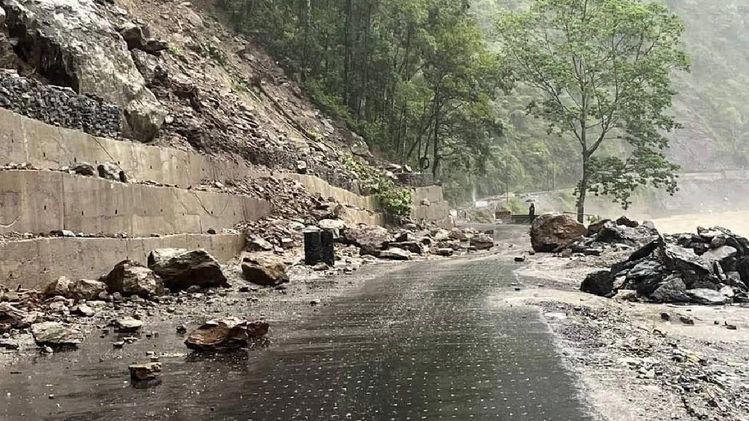
The Sikkim government has expressed serious concern over the recurring closures of National Highway-10, the lifeline that connects the state with the rest of India. In a recent communication to the National Highways and Infrastructure Development Corporation Limited (NHIDCL), the state government urged immediate action to ensure uninterrupted connectivity and permanent restoration of the highway.
The NH-10 route, which links Siliguri in West Bengal to Gangtok, has frequently faced disruptions due to landslides, road collapses, and heavy rains. These closures have severely affected transportation, supply of essential goods, and tourism — a vital sector for Sikkim’s economy. The government’s letter to NHIDCL highlights the urgent need for sustainable engineering solutions to prevent repeated damage.
Read More: Himanta Biswa Sarma Visits Baksa, Provides Aid to Victims of October 15 Clashes
NH-10: Sikkim’s Vital Economic Lifeline
National Highway-10 is more than just a road for Sikkim — it serves as the main trade and transport corridor between the state and the rest of India. Nearly all supplies, from food and fuel to construction materials, reach Sikkim through this route. However, frequent blockages have disrupted the state’s economic rhythm, leading to shortages and inflated prices.
Officials noted that the most affected stretches lie between Rangpo and Singtam, areas prone to heavy rainfall and soil erosion. The unstable terrain, combined with inadequate drainage systems, makes the highway vulnerable to frequent landslides. The Sikkim government NH-10 closures issue has thus become a recurring challenge that requires long-term planning rather than temporary repairs.
Chief Minister Prem Singh Tamang has repeatedly emphasized the importance of maintaining NH-10 in functional condition throughout the year. He has instructed state officials to coordinate closely with NHIDCL engineers and ensure that restoration works meet both safety and quality standards.
State Government’s Letter to NHIDCL
In its latest letter, the Sikkim government pointed out the inconvenience caused to residents and travelers by prolonged highway disruptions. The communication stressed that the NH-10 closures not only hinder daily commutes but also affect medical emergencies and logistics.
According to reports, the letter urged NHIDCL to conduct a detailed study on the affected zones and deploy advanced slope stabilization measures. It also requested the agency to increase manpower and machinery along the vulnerable stretches during monsoon months.
The Sikkim government NH-10 closures complaint also included recommendations for creating alternative routes and bypasses that can serve as emergency connections during blockages. Officials highlighted that relying solely on one route leaves the entire state vulnerable to isolation during natural calamities.
The government’s proactive stance reflects its growing concern for the welfare of citizens who depend on NH-10 for their livelihoods.
Impact on Trade, Tourism, and Daily Life
Frequent highway disruptions have had a ripple effect on every sector of Sikkim’s economy. For traders, transportation delays mean higher logistical costs. For farmers, perishable goods often fail to reach markets on time. And for tourists, uncertainty in road conditions has dampened travel enthusiasm.
The tourism industry, in particular, has suffered major losses during prolonged closures. Many visitors cancel trips due to safety concerns or inaccessibility. The Sikkim government NH-10 closures problem has thus become not only an infrastructure issue but also a significant economic concern.
Local residents living along the highway have also faced repeated hardships. Blocked routes mean delayed medical supplies and difficulty accessing hospitals in Gangtok or Siliguri. Educational institutions, too, face attendance challenges as students struggle to commute during prolonged roadblocks.
NHIDCL’s Role and Ongoing Measures
The NHIDCL is responsible for constructing and maintaining national highways in challenging terrains like Sikkim. In response to the state government’s concerns, NHIDCL officials have assured that restoration work is being carried out at full speed. Retaining walls, slope nets, and improved drainage systems are being installed in vulnerable zones to prevent further collapses.
However, state officials believe more needs to be done. The Sikkim government NH-10 closures issue demands long-term geological assessment and investment in preventive infrastructure rather than repetitive short-term fixes. Experts have suggested that modern technology like remote monitoring and slope sensors could help predict landslides and trigger early warnings for drivers.
NHIDCL has also proposed constructing tunnels and protective galleries at key points to reduce the risk of road damage during heavy rainfall. If implemented effectively, these measures could significantly reduce the frequency of blockages.
The Need for Sustainable Infrastructure
Sikkim’s geography presents unique challenges for road construction. The steep slopes and heavy monsoon rains make NH-10 particularly prone to erosion. Yet, as the Sikkim government NH-10 closures problem persists, there is a growing call for more sustainable and eco-friendly engineering practices.
Experts suggest using geotechnical reinforcement, vegetation cover, and better water diversion systems to stabilize slopes naturally. At the same time, coordination between the central and state agencies must improve to ensure timely maintenance.
The Sikkim government has also proposed that the Union Ministry of Road Transport and Highways allocate special funds for disaster-resistant highway infrastructure in hill states. This approach, officials believe, would ensure lasting solutions instead of repetitive emergency repairs.
Way Forward for NH-10 Connectivity
The Sikkim government’s firm stand on the NH-10 issue shows its dedication to ensuring uninterrupted access for its citizens. It has requested NHIDCL to fast-track restoration work before the next monsoon season.
Officials have also emphasized that maintaining NH-10 is not just about transport — it’s about ensuring economic stability, social well-being, and regional integration.
The government has urged for a high-level review meeting involving both NHIDCL and the Ministry of Road Transport to assess progress and plan future improvements. Continuous monitoring and timely interventions will be key to preventing future disruptions.
Sikkim’s dependence on NH-10 makes its maintenance a matter of national importance. As the Sikkim government NH-10 closures issue continues to impact daily life, swift and sustainable action is the only way forward. A stronger, safer, and resilient highway network will not only connect Sikkim to the rest of the country but also secure the future of its people and economy.
Read More: Meghalaya Police Destroy 10 Tonnes of Illegally Grown Cannabis in East Khasi Hills