


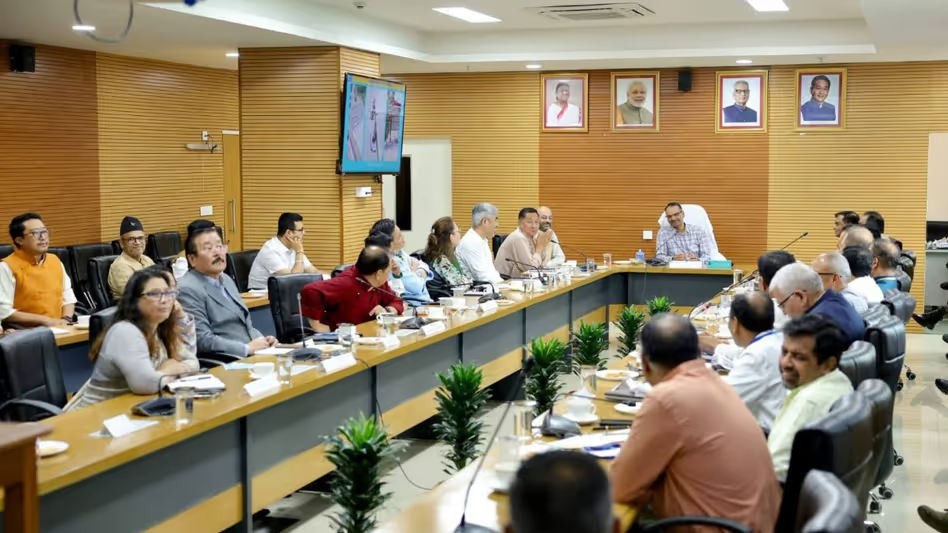
Sikkim Chief Secretary R. Telang chaired a high-level meeting at the Tashiling Secretariat to review preparations for potential Glacial Lake Outburst Floods (GLOFs) in the state. The meeting brought together state departments, central agencies, defence organisations, technical institutions and hydropower developers. Officials reviewed early warning systems, scientific studies, flood forecasting, infrastructure protection and mitigation plans for high-risk glacial lakes.
Special attention was given to Shako Chho Lake, one of Sikkim’s 16 Category A high-risk glacial lakes. The meeting also reviewed preparedness at the Gurudongmar and Lhonak complexes and stressed stronger community readiness, mock drills and inter-agency coordination.
Read More: ADC Land Rights Framework to Be Prepared Within 15 Days – Borok Times
Key Facts
- Location: Sikkim, Northeast India
- Meeting venue: Tashiling Secretariat
- Chaired by: Chief Secretary R. Telang
- Main concern: Glacial Lake Outburst Floods (GLOFs)
- Key high-risk lake: Shako Chho Lake
- Category A high-risk lakes in Sikkim: 16
- Major agencies involved: Central Water Commission, Geological Survey of India, Sikkim SDMA and technical institutions
- Previous major event: 2023 South Lhonak Lake GLOF
- Key measures: Early warning systems, flood forecasting, scientific monitoring, mitigation planning and preparedness drills
Sikkim Strengthens GLOF Preparedness
Sikkim has stepped up preparations to reduce the risks linked to Glacial Lake Outburst Floods. The state government reviewed ongoing measures and scientific studies during a high-level coordination meeting.
Chief Secretary R. Telang chaired the meeting at the Tashiling Secretariat. Representatives from multiple government departments and technical agencies attended the discussion.
The meeting focused on improving coordination and strengthening the state’s ability to detect, monitor and respond to glacial flood threats.
Lessons From 2023 South Lhonak GLOF
The Department of Science and Technology highlighted the significant losses caused by the 2023 South Lhonak Lake GLOF.
Officials discussed measures to improve preparedness for similar events in the future. These include stronger early warning systems and resilient infrastructure.
Plans also cover the protection of important roads, dams, bridges and settlements located in vulnerable areas.
Scientific Studies to Assess Glacial Risks
Authorities are conducting several scientific studies to understand the risks posed by glacial lakes.
These include hydrometeorological assessments, Electrical Resistivity Tomography, bathymetric surveys, hydrological and geological investigations and UAV-based terrain mapping.
Officials also discussed hydrodynamic modelling and the refinement of GLOF propagation scenarios. These studies will help authorities develop site-specific structural and non-structural mitigation measures.
Shako Chho Lake Gets Special Attention
Shako Chho Lake was a major focus of the meeting. Authorities have identified it as one of Sikkim’s 16 Category A high-risk glacial lakes.
The lake has no natural outlet and has an unstable configuration with a permeable moraine dam. Thangu village, the nearest habitation, lies around 13 kilometres downstream.
Because of the potential risk to downstream communities, officials stressed the importance of timely intervention.
Solar-powered pumps have been identified as a practical option to lower the lake’s water level. However, structural intervention has not been considered advisable, while a siphon system was assessed as unfeasible.
Mitigation Plans for Other Glacial Lakes
Authorities have also prepared mitigation strategies for other high-risk areas.
For the Gurudongmar Complex, officials have proposed a moraine plug-wall strategy. For the Lhonak Complex, a Preliminary Project Report has been submitted to the Ministry of Jal Shakti.
The Central Water Commission and Sikkim’s Department of Science and Technology are also working on a Detailed Project Report for a flood-retention structure at Dolma Sampa near Muguthang.
Monitoring and Flood Forecasting
The Central Water Commission presented updates on glacial lake monitoring, flow-path mapping and early warning systems.
The agency also discussed hydrological monitoring and flood forecasting to improve preparedness and provide authorities with timely information during potential flood events.
The Geological Survey of India presented a multi-hazard risk analysis along the Teesta River corridor from Zema to Meli.
The assessment covers flood dynamics, GLOF risks, slope stability and seismic vulnerability along the river corridor.
Hydropower Projects Under Review
The meeting also examined preparedness measures by NHPC and Greenko in the Teesta and Rangit basins.
Discussions covered early warning systems, risk assessments, monitoring, reservoir management and safety measures linked to hydroelectric projects.
These measures aim to reduce risks to infrastructure and downstream communities during extreme events.
Community Preparedness and Mock Drills
Relief Commissioner-cum-Secretary Rinzing Chewang Bhutia highlighted community sensitisation programmes and vulnerability mapping conducted by the Sikkim State Disaster Management Authority.
Sikkim University professors stressed the need for updated scientific assessments of high-risk glacial lakes. They also called for high-resolution ground data, drone-based mapping and improved modelling of debris flows and other downstream hazards.
Chief Secretary Calls for Reliable Alerts
Chief Secretary Telang stressed that Early Warning Systems must be efficient, reliable and capable of sending alerts at the earliest possible stage.
He also called for regular mock exercises and preparedness drills. Such exercises can improve coordination among agencies and strengthen response capacity.
Telang further emphasised close cooperation among scientific institutions, technical agencies, state departments, project developers, defence organisations and local administrations.
The coordinated approach aims to improve Sikkim’s readiness to respond to GLOFs and other hazards associated with the state’s fragile mountain environment.
Questions and Answers
What was the Sikkim government meeting about?
The meeting reviewed preparations and mitigation measures for potential Glacial Lake Outburst Floods in Sikkim.
Who chaired the meeting?
Sikkim Chief Secretary R. Telang chaired the high-level coordination meeting.
Which glacial lake received special attention?
Shako Chho Lake received particular attention because it is classified as one of Sikkim’s 16 Category A high-risk glacial lakes.
What happened at South Lhonak Lake in 2023?
A major GLOF from South Lhonak Lake caused significant losses in Sikkim in 2023, highlighting the need for stronger preparedness.
What measures are being planned?
Measures include early warning systems, scientific monitoring, flood forecasting, infrastructure protection, mitigation projects, vulnerability mapping and regular preparedness drills.
Location Context
Sikkim is a mountainous state in Northeast India and contains numerous glacial lakes and major river systems. Its high-altitude terrain makes scientific monitoring and early warning systems particularly important for protecting communities, infrastructure and hydropower projects from sudden glacial hazards.
Also Read: Assam Irrigation Projects Reviewed