


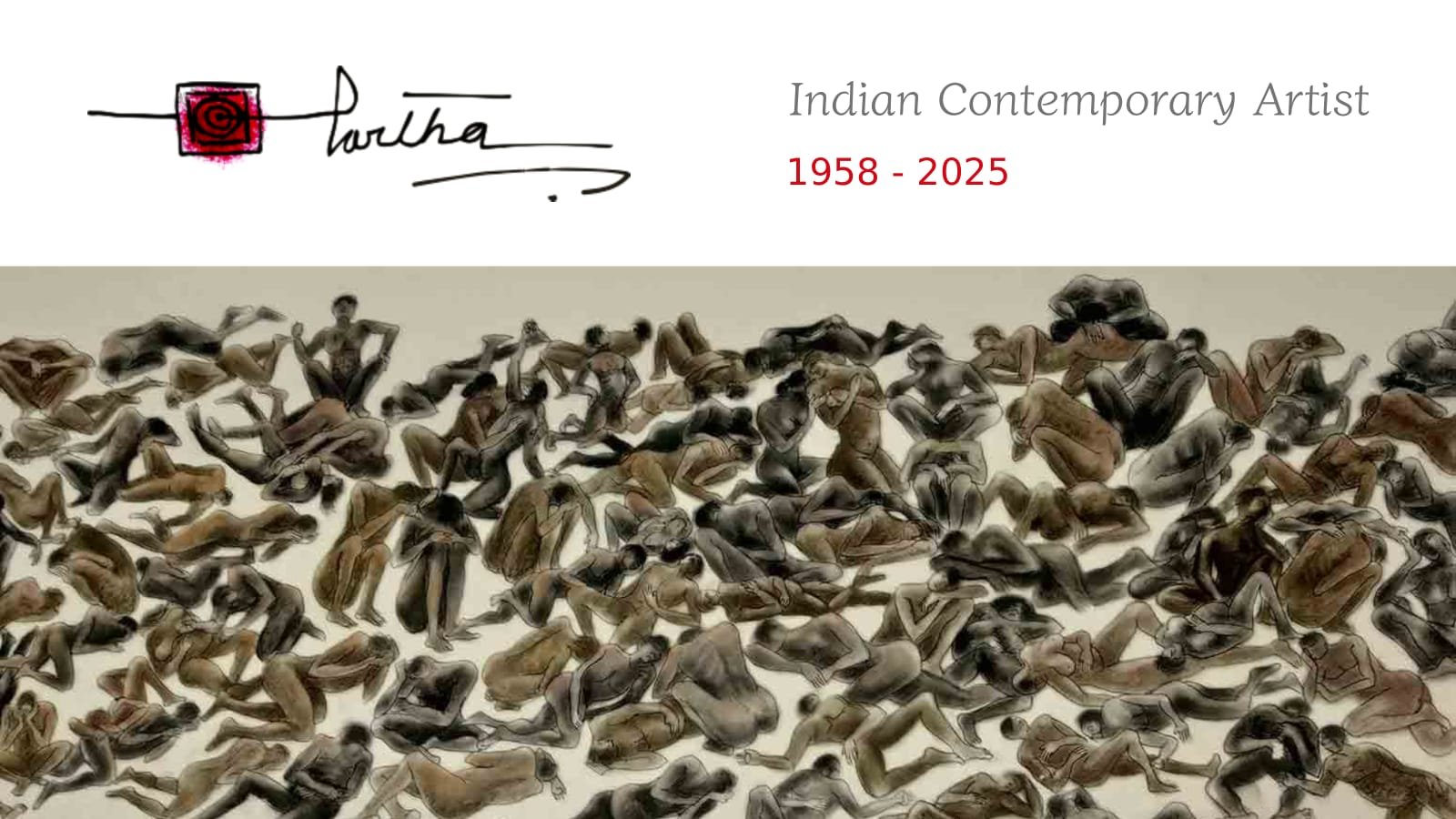
Some lives read like they were written for a purpose. Partha Bhattacharjee — born 1958, Chandannagore; died 2025; Indian contemporary artist, President Award winner, and one of the most spiritually committed painters of modern India — had exactly that kind of life. He grew up without money, fought to study art, worked as a railway porter to survive, met Satyajit Ray at a crossroads, chose the canvas over everything else, won the President Award, lost much of his sight, and kept painting. Every stage of it, lived with total conviction.
The body of work that life produced is extraordinary: oil paintings of such precision the eye believes it sees in three dimensions; dry pastels glowing with the warmth of Bengal’s folk traditions; mixed-media works on paper that bring Madhubani, Warli, Gond, and Patachitrainto a wholly original conversation. For collectors of rural Indian contemporary art and Indian contemporary art broadly, Partha Bhattacharjee is a figure whose work does not simply hang on a wall. It asks something of you.
Where He Came From
The youngest of five children in a middle-class Chandannagore family, Partha came to art the way most people come to the things that define them — sideways, through someone else. A mentor, Jyoti Prakash Mallick, who saw it and pointed him toward the Government College of Art and Craft in Kolkata. His family resisted. He persisted. Once inside, he found his people: Professor Ashesh Mitra, who taught him that art was philosophy before it was technique. He fell into Rembrandt’s light. He felt Van Gogh’s anguish as his own. He read the Kathamrita of Sri Sri Ramakrishna and understood, at a bone-deep level, what he was trying to do.
The Struggle That Shaped the Work
After college, survival required ingenuity. He tutored children, carried bags at railway stations, painted garages. He took teaching jobs in Orissa and Dhanbad. He joined the Reflection group of Calcutta and exhibited from 1988. A chance encounter with Satyajit Ray steered him away from film publicity and back to the canvas. These were the years that built the emotional architecture of everything that followed — the longing, the homesickness, and family expressed through the unflinching detail of oil paint.
The Spiritual Turning Point
The 1990s changed him. A journey to the Borra Caves on India’s east coast opened something that had been pressurising for years: a conviction that the ancient, essentially feminine life force underlying all existence was real, present, and visible — if you knew how to look. The Devi Series gave that conviction a form. Using Trompe-l’oeil — the Renaissance technique of creating optical illusions through photographic realism — Partha painted ordinary Indian women, in rural and urban settings, who are simultaneously, unmistakably divine, and he called it the Devi Series.
It was for this work that he received the President of India’s silver plaque for the best work of 2000-2001, awarded by the All-India Fine Arts and Crafts Society. The award-winning artist had found the subject that would anchor everything else.
Forty Years of Expanding Circles
Each decade brought new urgencies. The 2000s gave us the Sekal-Ekal (Then and Now) Series — the divine feminine across time — alongside the Krishna and Illusion Series. The 2010s saw him consciously turn away from European influence: Indian miniature forms, three-dimensional materials added to canvases, the Mahakal Series carrying his call for peace and justice, the Jesus Series recognising that compassion speaks across religions. Every shift was deliberate. Every series was a question answered and a new question asked.
Then, in 2017, a cerebral attack came and damaged his vision. He switched to dry pastel and mixed media on paper. He turned fully toward the folk traditions he had been absorbing for decades in the remote villages of Bengal, Orissa, and Maharashtra. The Companion Series, Migrant Worker Series, Mahakal Series, and Rural Series emerged — deeply felt, culturally rich, made by a man who knew his time was finite and refused to waste a moment of it.
The Philosophy That Never Changed
Through all of it — through poverty and recognition, through clear sight and compromised vision, through oils and pastels, through Rembrandt and Patachitra — one thing held constant. Partha Bhattacharjee said it himself: “I believe in a very simple philosophy of life. If I am honest and true to my art, I will reach the divine. This is the only form of prayer.”
Art as prayer. Honesty as the path. The canvas as the place where the earthly and the eternal briefly touch. He never stopped painting toward that. And in every work he left behind — whether you find it in oil or pastel, on canvas or paper — you can feel exactly how close he got.
Visit his website to check his work: https://parthabhattacharjee.com/