


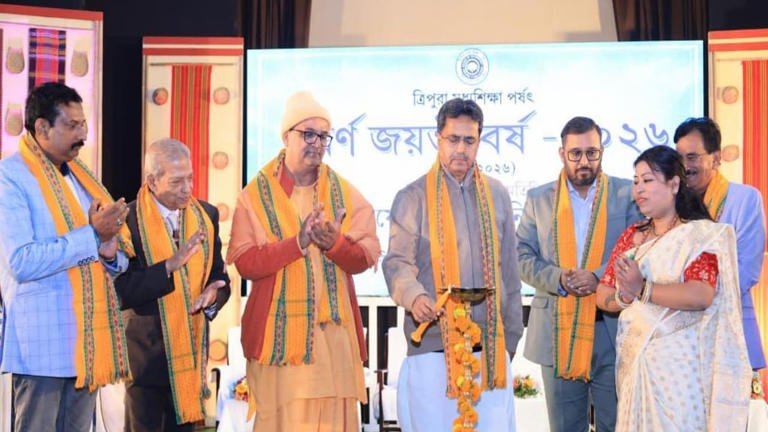
Tripura Chief Minister Dr. Manik Saha recently emphasized a transformative shift in the state’s academic landscape. During the Golden Jubilee celebrations of the Tripura Board of Secondary Education (TBSE) on January 1, 2026, the Chief Minister highlighted that the era of relying solely on textbooks is evolving. He urged the student community to embrace practical education through modern technology to stay competitive in a rapidly changing global economy.
Speaking at Nazrul Kalakshetra in Agartala, Dr. Saha underscored that while academic knowledge provides a foundation, it is the application of that knowledge that defines success. He believes that integrating practical education through modern technology is not just an option but a necessity for the youth of “New Tripura.” Education is the medium through which one establishes a distinct identity, and the CM noted that for a truly bright future, students must combine technical skills with morality and mental peace.
Read More: Agartala Smart City Focuses on Clean Water
Strategic Integration of NEP 2020 and Digital Tools
The Tripura government has been proactive in aligning its state policies with the National Education Policy (NEP) 2020. This alignment is designed to make the learning process more student-centric and timely. By linking technology with classroom instruction, the state aims to become a regional hub for educational excellence. To achieve this, the government has launched several key initiatives supporting practical education through modern technology.
Programs like Nipun Tripura and Mission Mukul focus on foundational literacy, while the Vidya Setu Module serves as a bridge for young learners. The state has also introduced the Vidya Samiksha Kendra, which uses Artificial Intelligence (AI) to monitor student progress and improve learning outcomes. Additionally, the “Super 30” project continues to support meritorious students in their pursuit of higher education and professional careers.
Improving Infrastructure for Practical Education through Modern Technology
A significant part of the Chief Minister’s address focused on inclusivity and infrastructure. To ensure that students from all backgrounds can access practical education through modern technology, the government is expanding both physical and digital facilities across the state.
Smart classrooms have already been introduced in over 1,200 schools, and Information and Communication Technology (ICT) is being implemented in nearly 1,400 institutions. Furthermore, the state is addressing the needs of tribal areas by constructing 47 new hostels under projects like PM Janman. The goal is to establish one Eklavya Model Residential School in each of the 58 blocks of Tripura to bridge the rural-urban divide in education.
Teacher Training and Future Readiness
Dr. Saha highlighted that the success of these reforms relies heavily on educators. So far, approximately 7,700 teachers have received specialized training to deliver practical education through modern technology effectively. This ensures that the teaching workforce remains updated with the latest digital tools and pedagogical methods required by the NEP 2020.
By fostering an environment where technology meets traditional moral values, Tripura is setting a precedent for holistic development. The felicitation of 23 meritorious students during the TBSE event served as a testament to the rising academic standards under this vision. As the state moves forward, the focus remains on producing skilled, ethical, and tech-savvy citizens.
The roadmap laid out by CM Manik Saha is clear: the future belongs to those who can master the tools of tomorrow today. By prioritizing practical education through modern technology, Tripura is ensuring its youth are not just degree holders, but innovators ready to lead the nation toward the goal of Viksit Bharat.
Read More: Jindal Seeks Satellite Station for Kurukshetra