


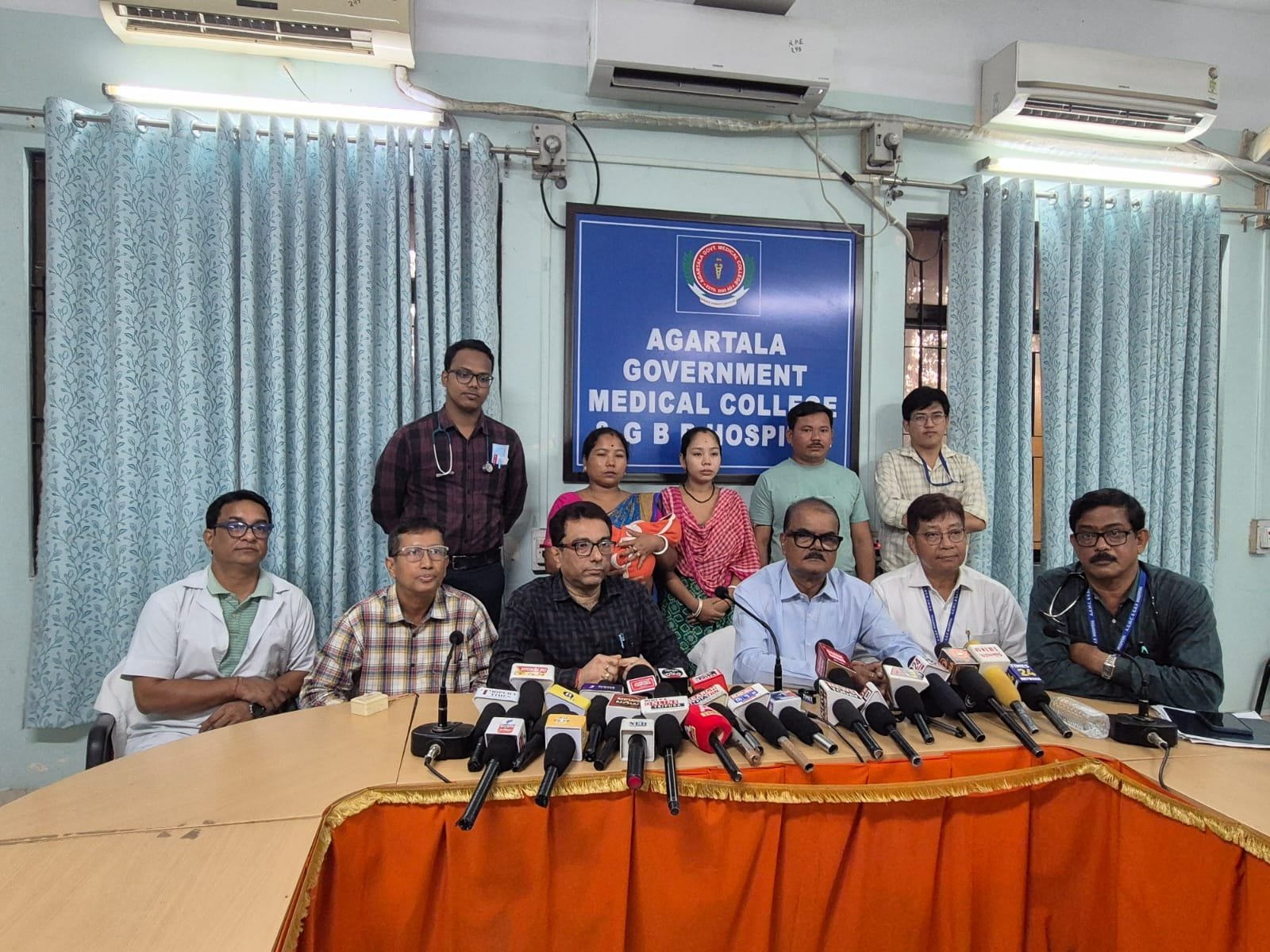
Agartala, Tripura: Doctors at Agartala Government Medical College and GBP Hospital (AGMC & GBPH) successfully performed a complex surgery to save a newborn girl suffering from a life-threatening congenital defect involving an abnormal connection between her food pipe and windpipe. The infant, who arrived at the hospital in critical condition on October 5, underwent surgery on October 7.
A specialised medical team repaired the defect and provided intensive neonatal care. Following the procedure, the baby recovered steadily and resumed breastfeeding. Moreover, the hospital provided the entire treatment free of cost under the government’s Janani Shishu Suraksha Karyakram (JSSK) scheme.
Read More: Tripura: Tipra Motha Leaders Discuss Tiprasa Accord Implementation, Civic Poll Strategy in Agartala
Key Facts About the Newborn Surgery in Tripura
- Location: AGMC & GBP Hospital, Agartala, Tripura
- Patient: Newborn baby girl from South Tripura
- Family’s Residence: Gabtali, under P.R. Bari Police Station
- Hospital Admission: October 5, 2026
- Surgery Date: October 7, 2026
- Medical Condition: Tracheo-esophageal fistula
- Surgical Procedure: Right-sided thoracotomy and fistula repair
- Lead Surgeon: Dr. Kanak Narayan Bhattacharya
- NICU Supervisor: Dr. Shribas Das
- Anaesthesia Team: Dr. Rimjhim Chakma and Dr. Manimay Debbarma
- Treatment Cost: Free under the JSSK scheme
- Patient’s Condition: Recovering well and breastfeeding normally
Newborn Girl Referred to AGMC Hospital in Critical Condition
The newborn girl belongs to a family from Gabtali in South Tripura’s P.R. Bari Police Station area.
According to hospital sources, the baby developed serious health complications shortly after birth.
She experienced difficulty swallowing, excessive frothing from her mouth and progressively worsening breathing problems.
Consequently, doctors referred her to AGMC & GBP Hospital in Agartala around midnight on October 5.
The infant reached the hospital barely six hours after birth.
Given her critical condition, doctors immediately admitted her to the Neonatal Intensive Care Unit (NICU).
Doctors Diagnose Life-Threatening Congenital Defect
Following admission, the Pediatrics Department began emergency treatment to stabilise the newborn.
Dr. Shribas Das, Associate Professor and Unit In-charge, supervised the initial medical management.
Meanwhile, doctors conducted clinical examinations and a chest X-ray to identify the underlying problem.
The findings raised suspicion of a tracheo-esophageal fistula, a serious congenital abnormality.
This condition creates an abnormal passage between the trachea, commonly known as the windpipe, and the esophagus or food pipe.
As a result, food or saliva can enter the respiratory tract and cause dangerous breathing complications.
Therefore, doctors recognised the need for urgent surgical intervention.
AGMC Surgeons Perform Complex Operation on October 7
After assessing the infant’s condition, the medical team prepared her for surgery.
On October 7, Dr. Kanak Narayan Bhattacharya, Consultant in Cardiothoracic and Vascular Surgery (CTVS), led the surgical procedure.
The team performed a right-sided thoracotomy to access and repair the abnormal connection.
Additionally, Dr. Rimjhim Chakma and Dr. Manimay Debbarma provided cardiac anaesthesia support throughout the operation.
The surgeons successfully repaired the fistula, marking a significant achievement for the hospital’s neonatal surgical services.
Following the procedure, doctors transferred the newborn back to intensive care for close monitoring.
Newborn Recovers After 12 Days of Intensive Care
The infant remained under continuous medical observation in the NICU following surgery.
Initially, doctors provided nutrition through a feeding tube to support her recovery.
Meanwhile, the medical team closely monitored her breathing, feeding ability and overall condition.
After seven days, doctors removed the feeding tube.
Subsequently, the newborn successfully resumed breastfeeding directly from her mother.
After 12 days of intensive care, doctors shifted the baby to the neonatal ward.
According to hospital sources, the infant is now healthy and recovering well alongside her mother.
Furthermore, doctors expect to discharge her soon.
Entire Treatment Provided Free Under JSSK Scheme
The hospital provided the newborn’s complete treatment without charging the family.
The medical expenses fell under the government’s Janani Shishu Suraksha Karyakram (JSSK).
The scheme aims to reduce financial barriers to maternal and newborn healthcare in public health institutions.
In this case, the family received emergency medical care, surgery and neonatal treatment without out-of-pocket expenses.
Moreover, the financial support allowed the parents to focus on their daughter’s recovery.
The case highlights the importance of accessible specialised healthcare for families facing medical emergencies.
Why Is This Medical Achievement Important for Tripura?
Tripura is a northeastern Indian state where specialised government hospitals play a crucial role in treating patients from urban and rural communities.
AGMC & GBP Hospital in Agartala serves as an important referral centre for patients requiring advanced medical treatment.
Therefore, the successful operation demonstrates the hospital’s ability to manage complex neonatal surgical emergencies.
Additionally, the coordinated efforts of pediatric specialists, surgeons and anaesthesia professionals contributed to the newborn’s recovery.
The achievement also highlights the importance of timely referrals, intensive care and government-supported treatment.
Frequently Asked Questions (FAQs)
1. What surgery did doctors perform at AGMC & GBP Hospital?
Doctors performed a right-sided thoracotomy and repaired a tracheo-esophageal fistula in a newborn girl.
2. What is a tracheo-esophageal fistula?
It is a congenital condition involving an abnormal connection between the food pipe and windpipe. The defect can cause feeding difficulties and serious breathing problems.
3. Who performed the newborn’s surgery?
Dr. Kanak Narayan Bhattacharya led the operation, with anaesthesia support from Dr. Rimjhim Chakma and Dr. Manimay Debbarma.
4. When did the surgery take place?
The medical team performed the operation on October 7, 2026, two days after the infant reached the hospital.
5. How much did the newborn’s treatment cost?
The family paid nothing because the hospital provided the entire treatment under the Janani Shishu Suraksha Karyakram scheme.
6. What is the newborn’s current health condition?
According to hospital sources, the baby is healthy, breastfeeding normally and recovering well. Doctors expect to discharge her soon.
Successful Surgery Highlights Tripura’s Neonatal Healthcare Capabilities
The successful operation at AGMC & GBP Hospital saved a newborn facing a life-threatening congenital abnormality.
Through timely diagnosis, specialised surgery and intensive neonatal care, doctors helped the infant recover.
Furthermore, free treatment under the JSSK scheme ensured that the family received essential healthcare without financial hardship.
The case represents an important achievement for government-supported neonatal healthcare in Tripura.
Also Read: Mizoram Records 721 Respiratory Disease Deaths in 2025, Highest Among Medically Certified Fatalities