


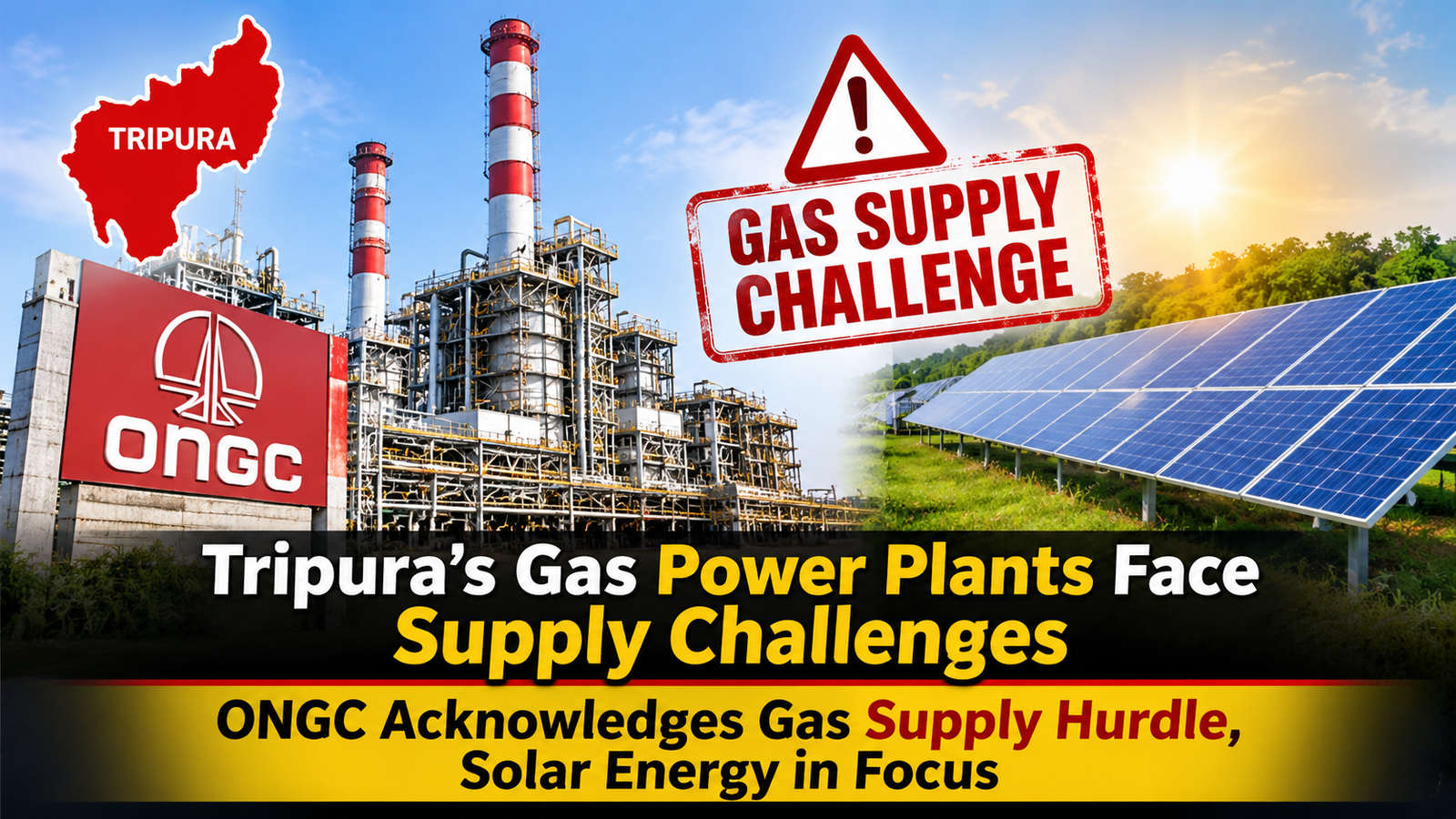
Tripura’s gas-based power sector is facing growing challenges as production from ageing natural gas fields continues to decline. The state, which became power-surplus after commissioning major gas-based plants, now faces questions about the long-term reliability of its fuel supply. ONGC has acknowledged difficulties in maintaining gas production but says exploration successes and new discoveries could help improve supplies. The company is focusing on developing gas reserves in South Tulamura, North Baramura and Khubal. Meanwhile, concerns over fuel availability have renewed calls for Tripura to accelerate solar energy development and diversify its electricity generation sources.
Read More: Tripura Faces Scrutiny Over Major Scandals
Key Facts About Tripura’s Gas Supply Challenge
- Main issue: Declining natural gas production from ageing fields.
- Key organisation: Oil and Natural Gas Corporation (ONGC).
- Major power plants: OTPC Palatana, NEEPCO Monarchak, TSECL Rokhia, Baramura and NEEPCO RC Nagar.
- Palatana capacity: 726.6 MW installed capacity.
- New exploration areas: South Tulamura and North Baramura.
- Gas connectivity: Proposed integration with the Indradhanush Gas Grid Limited (IGGL) network.
- Proposed alternative: Faster development of solar energy projects.
Tripura’s Gas-Based Power Journey
Natural gas has played a major role in Tripura’s economic development and electricity generation. The state’s journey began in 1986 when the Tripura State Electricity Corporation Limited (TSECL) established its first gas-based power plant at Baramura.
The expansion continued with the commissioning of OTPC Palatana in 2014 and NEEPCO Monarchak in 2015. As a result, Tripura became a power-surplus state and started supplying electricity to neighbouring states and Bangladesh.
ONGC has remained a key supplier of natural gas for these power stations through its fields across Tripura.
Ageing Gas Fields Create Supply Concerns
However, production from several mature gas fields has declined over the years. Ageing wells, falling reservoir pressure and increasingly challenging extraction conditions have affected the availability of natural gas.
These developments have raised concerns about the fuel requirements of major power stations, including Palatana, Monarchak, Rokhia, Baramura and RC Nagar.
The Palatana power plant, operated by ONGC Tripura Power Company (OTPC), has an installed capacity of 726.6 MW. However, reports indicate that the plant has operated substantially below its capacity because of inadequate gas availability.
Although ONGC’s Tripura Asset Manager has not accepted that every power plant faces a severe shortage, he has acknowledged certain supply-related difficulties.
ONGC Focuses on New Gas Discoveries
ONGC’s Tripura Asset Manager has expressed optimism about the company’s efforts to address the production challenge. According to him, successful exploration has helped arrest the decline in production, while overall gas output is showing signs of improvement.
The company is now prioritising the faster development of new discoveries in South Tulamura and North Baramura. Both areas present operational challenges, particularly because parts of the exploration locations fall within forest areas.
ONGC has also initiated the Right of Use (ROU) process to connect these discoveries with existing surface infrastructure. In addition, the upcoming IGGL gas trunk line could support the monetisation of the Khubal field.
The company is pursuing further drilling projects using advanced rigs and cluster drilling techniques. By using existing well sites and infrastructure, cluster drilling can reduce development costs and limit the need for fresh land acquisition and clearances.
ONGC is also working with state authorities and regulatory agencies to secure the necessary forest, wildlife and environmental approvals for exploration in remote areas.
Solar Energy Gains Importance in Tripura
Despite ONGC’s exploration efforts, the declining output from mature gas fields highlights the need for a broader energy strategy.
Solar power could help Tripura reduce its dependence on natural gas and strengthen electricity security. It could also provide an alternative source of generation when gas supplies become constrained.
The proposed integration with the IGGL network may further improve regional gas connectivity and provide additional flexibility in meeting future fuel requirements.
Questions and Answers
Q1. Why is Tripura facing gas supply challenges?
Production from ageing gas fields has declined because of mature reservoirs, falling pressure and difficulties in extracting additional gas.
Q2. Which major power plant is affected by gas availability concerns?
OTPC Palatana, which has an installed capacity of 726.6 MW, has reportedly operated below capacity because of inadequate gas supplies.
Q3. What is ONGC doing to improve gas production?
ONGC is pursuing new discoveries, drilling projects, cluster drilling and faster development of reserves in South Tulamura, North Baramura and Khubal.
Q4. How could the IGGL network help Tripura?
The proposed gas grid connection could strengthen regional connectivity and support the development of new gas fields.
Q5. Why is solar energy becoming important?
Solar power could diversify Tripura’s energy sources and reduce its dependence on natural gas.
Tripura Needs a Diversified Energy Strategy
Tripura is an important natural gas-producing state in Northeast India, and its power infrastructure has supported both regional development and electricity exports. However, declining production from mature fields makes it increasingly important to balance fresh exploration with renewable energy development.
A combination of stronger gas production, improved infrastructure, regional connectivity and faster solar expansion will be essential to ensure a reliable and sustainable electricity supply for the state.
Also Read: Sikkim CM Attends Amitabha School Annual Concert