


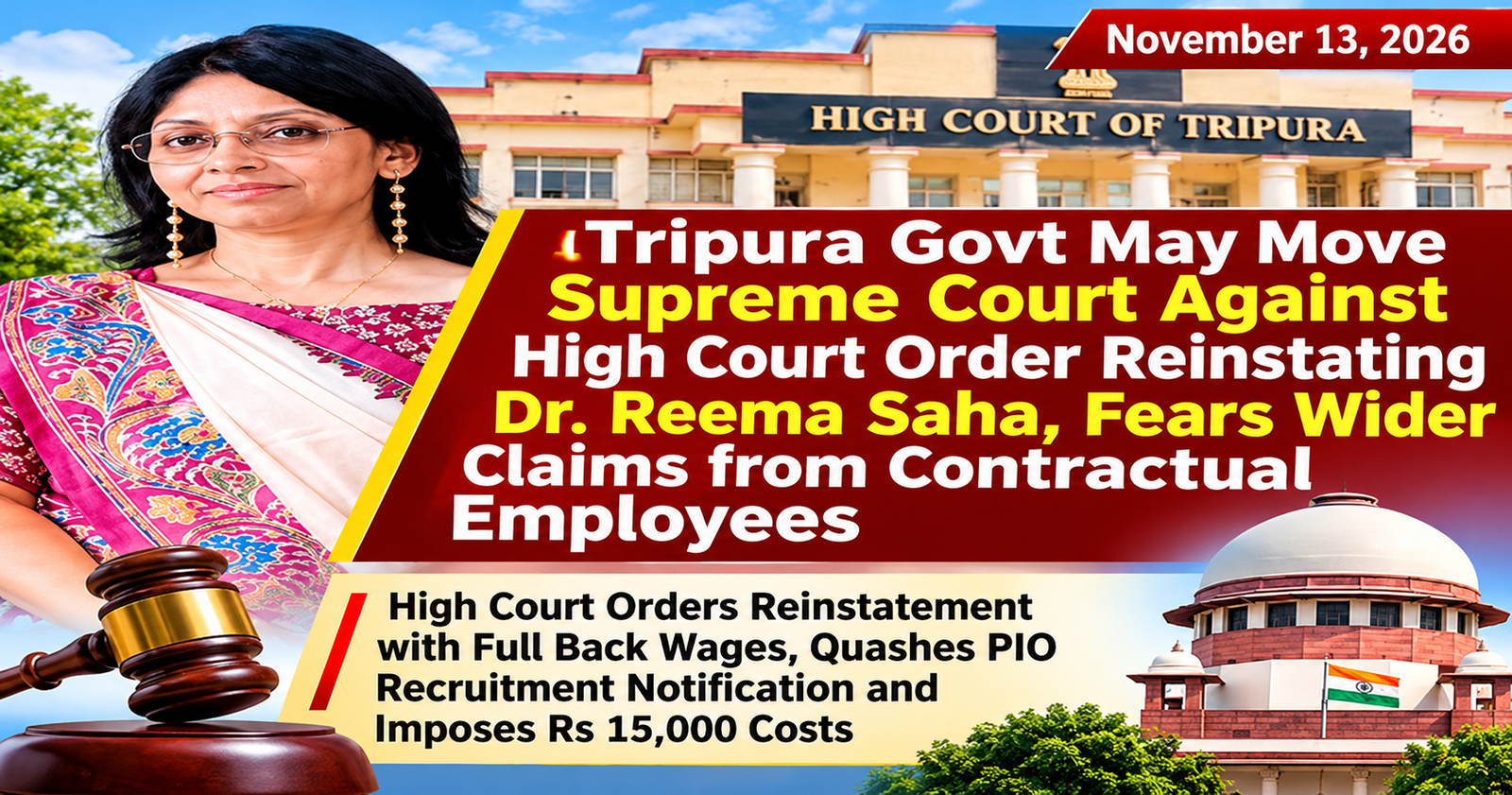
The Tripura Government is reportedly considering a legal challenge to the November 11 judgment of the Tripura High Court that ordered the reinstatement of Dr. Reema Saha as Project Implementing Officer (PIO) of the Indo-German Development Cooperation (IGDC) Climate Resilient Forest Landscapes in Tripura (CREFLAT) Project. The Division Bench also directed the authorities to pay her full back wages after finding her discontinuation arbitrary and unreasonable.
Meanwhile, the government is assessing the legal, administrative and financial implications of the ruling. Sources indicate that officials may consider filing a Special Leave Petition (SLP) before the Supreme Court of India. The case could also influence future disputes involving contractual employees across Tripura.
Read More: Agartala Press Club Flags Journalist Identity Misuse
Key Facts About the Tripura High Court Judgment
- Location: Agartala, Tripura
- Judgment date: November 11, 2026
- Employee: Dr. Reema Saha
- Position: Project Implementing Officer (PIO)
- Project: IGDC-CREFLAT Project
- Initial engagement: February 2021
- Last contractual extension: September 25, 2025
- High Court direction: Reinstatement with full back wages
- Recruitment notification: November 5, 2025
- Cost imposed: ₹15,000
- Possible next step: Special Leave Petition before the Supreme Court
Tripura Government Examines Possible Supreme Court Appeal
The Tripura Government is reportedly examining whether to challenge the Division Bench’s decision before the Supreme Court.
Officials are understood to be reviewing the judgment’s legal and financial consequences. In particular, the government is concerned about its possible impact on contractual appointments across departments, government-controlled societies, autonomous bodies and externally funded projects.
Tripura employs a substantial number of people on contractual, temporary, outsourced and project-based terms. Many workers have continued in their positions through repeated extensions over several years.
Consequently, the latest judgment could encourage similarly placed employees to seek legal remedies if authorities discontinue their services without following fair procedures.
However, the government has not been reported to have filed an SLP yet. Any appeal would require a separate decision by the competent authorities.
Dr. Reema Saha’s Contractual Appointment and Discontinuation
According to information presented in the case, the Society for Entrepreneurship Development (SoFED) initially engaged Dr. Reema Saha in February 2021.
The appointment covered an 11-month contractual period. Subsequently, the authorities extended her engagement on several occasions.
Her final extension ended on September 25, 2025. The authorities argued that her position involved a fixed tenure and that they had decided against another extension based on project requirements and a performance assessment.
However, Dr. Saha challenged the decision, arguing against the discontinuation of her services.
High Court Questions Performance Assessment
The Division Bench examined the circumstances surrounding the decision not to extend Dr. Saha’s engagement.
The judges found the discontinuation arbitrary and unreasonable. They also held that the authorities had violated Article 14 of the Constitution and the principles of natural justice.
A significant issue involved the performance appraisal that the authorities relied upon to justify their decision.
The Bench questioned its credibility because a junior officer had prepared the assessment. It also noticed an apparent alteration in the appraisal’s date.
Furthermore, the authorities had not issued Dr. Saha a show-cause notice or prior warning about her alleged poor performance before ending her engagement.
The Court also clarified that SoFED had directly appointed Dr. Saha. Therefore, the authorities could not simply classify her as an outsourced employee hired through a third-party contractor.
Background of the Legal Battle
Dr. Saha initially approached the Tripura High Court through WP(C) No. 660 of 2025 after the authorities declined to extend her contractual engagement.
On May 18, 2026, a Single Judge dismissed her petition. The decision primarily relied on the principle that contractual employees cannot automatically claim regularisation, permanent government employment or absorption into government service.
Dr. Saha subsequently challenged that decision through Writ Appeal No. 102 of 2026.
The Division Bench, comprising Chief Justice M.S. Ramachandra Rao and Justice S. Datta Purkayastha, examined the appeal. It concluded that the earlier judgment had not adequately addressed the central question of whether the authorities had legally discontinued her services.
As a result, the Bench set aside the Single Judge’s decision and granted relief to Dr. Saha.
High Court Orders Reinstatement and ₹15,000 Costs
The Division Bench issued several directions in its November 11 judgment.
First, it quashed the November 5, 2025 recruitment notification insofar as it concerned the Project Implementing Officer post.
Second, the Court directed the authorities to reinstate Dr. Saha immediately and pay her full back wages.
Additionally, the Bench directed respondent No. 5, the Chief Executive Officer and Project Director of the IGDC-CREFLAT Project, to pay ₹15,000 in costs to Dr. Saha within four weeks.
These directions have placed the government in a position where it must consider the legal and administrative consequences of implementing the order or challenging it before the Supreme Court.
Why the Judgment Matters for Contractual Employees in Tripura
The case extends beyond one employee and one project. It raises important questions about how government departments and publicly funded organisations manage contractual appointments.
The judgment could influence disputes involving employees who have received repeated extensions but later face discontinuation.
It also highlights the importance of transparent performance assessments, proper documentation and fair procedures before authorities terminate or discontinue contractual engagements.
At the same time, the case does not automatically grant permanent employment or regularisation to all contractual workers. Instead, its wider significance concerns the legal standards that authorities must follow when making employment decisions.
What Happens Next?
The Tripura Government is reportedly assessing the possibility of approaching the Supreme Court. If it decides to file an SLP, the legal challenge could examine the scope of judicial review in contractual appointments and the role of natural justice in decisions involving fixed-tenure employees.
The outcome may also clarify the standards that government-controlled societies and externally funded projects must follow when assessing performance and discontinuing contractual staff.
Frequently Asked Questions
1. Why may the Tripura Government approach the Supreme Court?
The government is reportedly considering an SLP against the High Court judgment directing Dr. Reema Saha’s reinstatement with full back wages.
2. Which position did Dr. Reema Saha hold?
She worked as the Project Implementing Officer of the IGDC-CREFLAT Project.
3. Why did the High Court order her reinstatement?
The Division Bench found her discontinuation arbitrary and unreasonable. It also questioned the performance appraisal and noted the absence of a show-cause notice or prior warning.
4. What compensation did the High Court order?
The Court directed the authorities to pay Dr. Saha full back wages. It also imposed ₹15,000 in costs.
5. Does the judgment guarantee permanent jobs to contractual employees?
No. The judgment does not automatically grant regularisation. However, it highlights the importance of following constitutional principles and fair procedures when discontinuing contractual employees.
Conclusion
The Tripura High Court’s decision in Dr. Reema Saha’s case has brought contractual employment practices under fresh scrutiny. While the government considers its next legal move, the ruling highlights the importance of transparent performance assessments and fair procedures.
If the government approaches the Supreme Court, the case could become significant for contractual employees and government-controlled organisations across Tripura and the wider Northeast. For now, the legal and administrative implications of the judgment remain under consideration.
Also Read: Manipur: Two Insurgent Cadres Arrested, 745 Bottles of Codeine Syrup Seized in Three Operations