


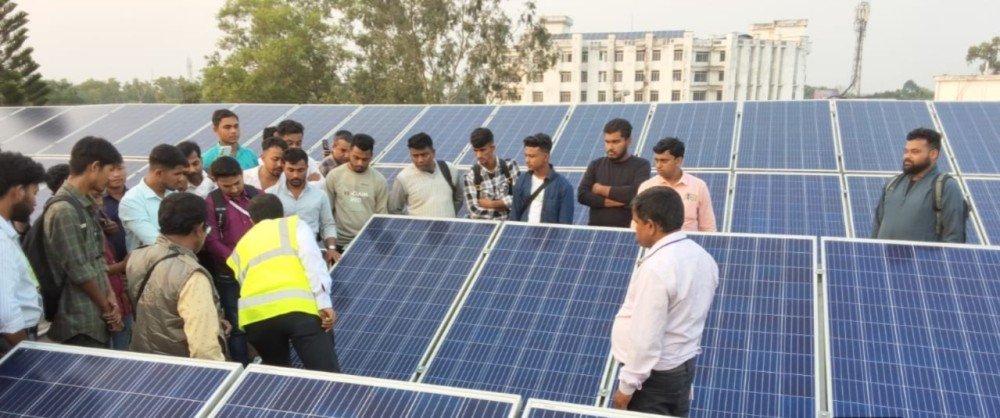
Tripura solar power generation is set to receive a major boost, as the state’s installed capacity is expected to cross 10 megawatts by March 2026, officials said. The development marks a significant milestone in Tripura’s renewable energy journey and reflects the government’s growing focus on sustainable power sources. At present, the state is steadily expanding its solar infrastructure through a mix of government-led and decentralised projects.
According to officials, the planned expansion aligns with national renewable energy goals and aims to reduce dependence on conventional power sources. Moreover, the initiative is expected to strengthen Tripura’s energy security while promoting environmentally responsible development.
Read More: Jorhat’s Aishi Prisha Borah Wins PM Bal Puraskar
Tripura Solar Power Generation Sees Steady Expansion
Tripura solar power generation has witnessed gradual progress over the past few years. Currently, several small and medium-scale solar projects are operational across the state. These include rooftop solar installations on government buildings, educational institutions, and health facilities. In addition, ground-mounted solar plants are being developed in selected locations.
Officials stated that ongoing projects, combined with new installations planned over the next year, will help Tripura surpass the 10 MW mark. Therefore, the state is moving closer to its medium-term renewable energy targets. Notably, the expansion also complements the central government’s emphasis on clean energy transition.
Furthermore, Tripura’s geographical conditions, including adequate sunlight availability, make solar power a viable and sustainable option. As a result, authorities are prioritising solar energy as a key component of the state’s power mix.
Government Initiatives Driving Solar Growth
Several government initiatives are contributing to the growth of Tripura solar power generation. Under various central and state schemes, incentives are being provided to promote rooftop solar adoption. Consequently, households, institutions, and commercial establishments are increasingly showing interest in solar installations.
Additionally, officials noted that awareness programmes have played a crucial role in encouraging participation. These programmes educate consumers about long-term cost savings and environmental benefits. Meanwhile, simplified approval processes have helped speed up project implementation.
The Tripura Renewable Energy Development Agency continues to coordinate with central agencies to ensure timely execution of projects. As a result, the pace of solar deployment has improved compared to previous years.
Focus on Rooftop and Decentralised Solar Projects
Rooftop solar systems form a major part of Tripura’s renewable energy strategy. According to officials, decentralised solar generation helps reduce transmission losses and improves energy efficiency. Therefore, government buildings are being prioritised for rooftop installations.
Moreover, decentralised solar projects provide power solutions in remote and rural areas where grid connectivity can be challenging. In such regions, solar energy supports essential services such as lighting, healthcare, and water supply.
Similarly, solar-powered streetlights and irrigation systems are being promoted to enhance rural infrastructure. These initiatives not only improve quality of life but also reduce dependence on fossil fuels.
Environmental and Economic Benefits for the State
The expansion of Tripura solar power generation is expected to bring multiple environmental benefits. By increasing the share of renewable energy, the state can significantly reduce carbon emissions. Consequently, this contributes to climate action efforts at both state and national levels.
From an economic perspective, solar projects create employment opportunities during installation and maintenance phases. Additionally, reduced electricity costs over time can ease financial pressure on public institutions.
Officials also pointed out that investing in renewable energy enhances long-term energy stability. Therefore, solar power is seen as a strategic asset for Tripura’s future development.
Alignment With National Renewable Energy Goals
Tripura’s solar expansion aligns closely with India’s broader renewable energy ambitions. The central government has set ambitious targets to increase solar capacity nationwide. In this context, Tripura’s progress reflects cooperative federalism in action.
Moreover, officials said that continued support from central schemes will remain crucial in achieving future targets. As policies evolve, the state plans to explore innovative technologies and storage solutions to improve efficiency.
At the same time, authorities are assessing potential challenges such as land availability and grid integration. Addressing these issues early is expected to ensure smoother expansion.
Road Ahead for Tripura’s Solar Sector
Looking ahead, Tripura solar power generation is likely to witness further growth beyond 2026. Officials indicated that feasibility studies are underway to identify new project sites. Additionally, partnerships with private players may be explored to accelerate capacity addition.
As the state moves toward its renewable energy goals, solar power is expected to play an increasingly important role. Ultimately, crossing the 10 MW milestone will not only mark a numerical achievement but also signal Tripura’s commitment to a cleaner and more sustainable energy future.
With consistent policy support and public participation, Tripura’s solar journey appears well-positioned for long-term success.
Read More: India and Nepal Bolster Healthcare Ties: Focus on Medicine Supply and Capacity Building