


A Voice for the Persecuted, A Shield for the Displaced
In every democracy, there are moments that test not only institutions but also the character of individuals. History often remembers political victories and electoral outcomes, but the true strength of a society is measured by those who stand beside the vulnerable when fear, violence, and uncertainty threaten to overwhelm them.
In the aftermath of the 2021 West Bengal Assembly Election, allegations of post-poll violence, displacement, intimidation, destruction of property, and violations of human rights dominated public discourse. While political debates continued across the state, countless families found themselves facing a more immediate reality—loss of security, fear for their future, and the struggle to rebuild their lives.
During this turbulent period, one name emerged repeatedly among those seeking legal protection and humanitarian support: Advocate Mita Banerjee.
For many affected families, she became more than a lawyer. She became a source of hope, a trusted guide, and a determined advocate who chose to stand with those who felt abandoned during one of the most challenging periods in recent political history.
Standing with Victims When It Mattered Most
The allegations surrounding post-poll violence attracted national attention and prompted interventions by institutions including the National Human Rights Commission (NHRC) and the Calcutta High Court.
While legal proceedings unfolded, many victims faced immediate hardships. Families reportedly fled their homes, political workers feared retaliation, and many struggled to access legal support at a time when they needed it most.
According to individuals who worked closely with her, Advocate Mita Banerjee stepped forward to provide legal assistance, guidance, and representation to numerous affected families.
Her contribution, however, extended far beyond legal advocacy.
Together with the support of her husband, Advocate Barun Kumar Ray, she reportedly helped arrange temporary shelter, food, clothing, and essential assistance for displaced families who had been forced to leave their homes. For many beneficiaries, this support represented more than material relief—it restored dignity, confidence, and hope during a period of uncertainty.
Her work reflected a belief that justice should not be limited to courtrooms. It should also reach people in their moments of greatest need.
Advocacy Beyond the Courtroom
The legal profession carries with it a responsibility to defend rights and uphold justice. Yet Advocate Mita Banerjee’s journey demonstrates that true advocacy often extends beyond litigation and legal proceedings.
Supporters describe her as a committed Sanatani voice who consistently stood beside individuals who felt unheard and unsupported. Through legal interventions, public awareness efforts, and direct humanitarian assistance, she sought to ensure that the suffering of victims was neither ignored nor forgotten.
For many families, justice was not simply about legal outcomes. It was about regaining confidence, restoring security, and finding the strength to move forward.
Her work became an example of how compassion and legal expertise can work together to create meaningful change in society.
Voices from the Ground

The impact of Advocate Mita Banerjee’s work is perhaps best reflected through the words of those who witnessed her efforts firsthand.
Pulakesh Pandit
BJP Worker
Speaking about his experience, Pulakesh Pandit recalled the difficulties he faced following the 2021 Assembly Election.
According to him:
“After the 2021 Assembly Election, I became a victim of violence arising from political differences. During that period, my house was vandalized, our party office was attacked, and we faced severe mental harassment. Similar allegations of attacks emerged again in 2024. During this difficult period, Advocate Mita Banerjee provided legal assistance against the accused and supported us without charging any remuneration.”
His testimony reflects the trust many individuals placed in Advocate Banerjee during periods of uncertainty and distress.
Tapati Das
BJP Worker
Tapati Das, who worked alongside Advocate Mita Banerjee while supporting victims of post-election violence, described her role in deeply personal terms.
According to Tapati Das:
“In 2021, I worked alongside Advocate Mita Di in supporting victims of post-election violence, where she not only provided legal aid and protection to affected BJP workers and their families but also stood by them with compassion and humanity. To us, she was far more than a lawyer—she became a guardian, mentor, and guiding force during one of the most difficult times.”
For many who interacted with her during that period, Advocate Mita Banerjee represented not only legal support but also emotional strength and reassurance.
Recognition for Service and Commitment
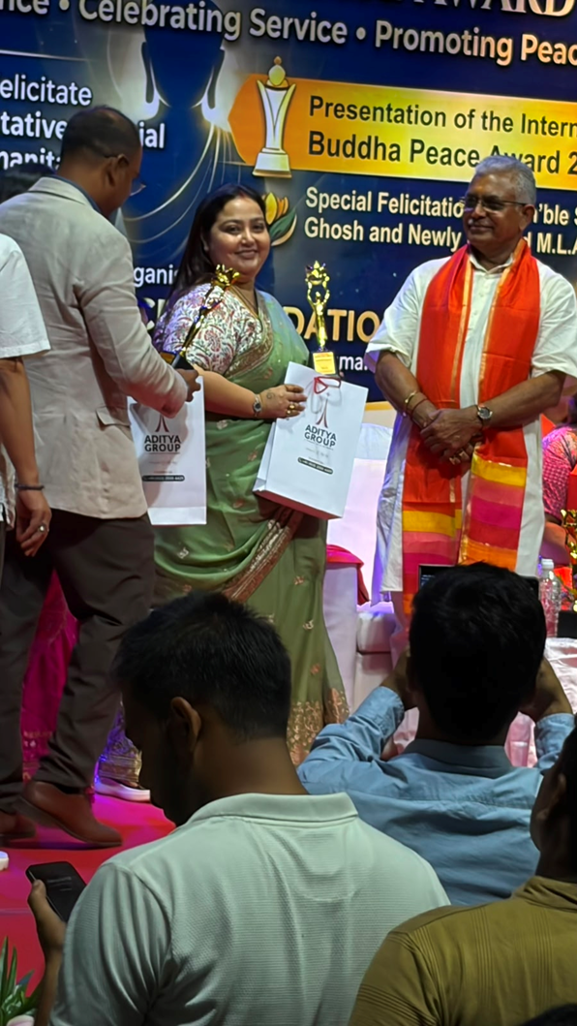
In recognition of her legal advocacy, humanitarian efforts, and unwavering support for victims and displaced families, Advocate Mita Banerjee was honoured with the prestigious International Buddha Peace Award.
The award was presented by West Bengal Government Minister Dilip Ghosh during a special ceremony held at the renowned Rabindra Tirtha Auditorium, New Town, Kolkata, on 4 June 2026.
The recognition was conferred in appreciation of her contribution to social justice, humanitarian relief, legal empowerment of the underprivileged, and her continued efforts to support families affected by political unrest.
The International Buddha Peace Award seeks to honour individuals whose work promotes peace, social welfare, humanitarian service, and the protection of human dignity.
For many observers and supporters, the award represented not only recognition of past achievements but also acknowledgment of a continuing mission dedicated to justice, compassion, and service.
A Mission Rooted in Faith, Culture, and Social Service
Beyond her legal career, Advocate Mita Banerjee and her husband, Advocate Barun Kumar Ray, are associated with Akhandya Bharatiya Sanatani Sangh.
The organization is dedicated to promoting Sanatani values, preserving Hindu culture, and encouraging awareness of Sanatan Dharma among people from diverse backgrounds.
According to its stated objectives, the Sangh seeks to promote spiritual awareness, preserve cultural traditions, protect religious rights, encourage social harmony, and undertake charitable initiatives that serve humanity.
Through legal awareness programmes, humanitarian outreach, community initiatives, and religious gatherings, the organization aims to connect individuals with India’s rich spiritual heritage while encouraging active participation in social welfare.
Supporters view Advocate Mita Banerjee and Advocate Barun Kumar Ray as individuals who have successfully combined legal activism with social and spiritual service.
Law, Compassion, and Courage
Every generation produces individuals who remind society that leadership is not defined solely by position or authority, but by the willingness to act when others hesitate.
Advocate Mita Banerjee’s journey reflects this principle.
Her work during periods of social and political turmoil demonstrates the profound impact that one determined individual can have on the lives of countless others. By combining legal advocacy with humanitarian service, she sought to address not only the legal consequences of conflict but also its human cost.
For supporters and well-wishers, her efforts symbolize a continuing commitment to justice, compassion, and service.
A Legacy of Service
The story of Advocate Mita Banerjee is ultimately a story of courage, commitment, and compassion.
It is the story of a legal professional who chose to stand beside displaced families when uncertainty prevailed. It is the story of an advocate who viewed justice not merely as a legal principle but as a moral responsibility. And it is the story of a humanitarian who understood that restoring dignity can be just as important as securing legal relief.
As her journey continues, Advocate Mita Banerjee remains an inspiring example of how law, humanity, faith, and courage can come together in the service of society.
In a world often divided by conflict and uncertainty, her work serves as a powerful reminder that justice is not measured solely by verdicts delivered in courtrooms, but by the lives touched, the voices protected, and the hope restored along the way.