


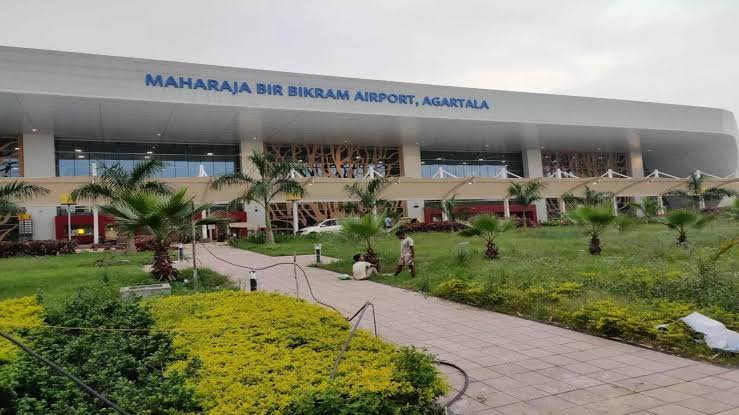
Agartala Airport cargo expansion is strengthening the logistics role of Maharaja Bir Bikram Airport as Tripura’s air connectivity continues to grow. The airport has expanded its cargo-handling infrastructure, including a domestic air cargo terminal commissioned in 2025 with a reported handling capacity of about 40,000 tonnes.
The development is significant for a state where air transport supports the movement of time-sensitive goods and produces. Moreover, rising passenger traffic and aircraft movements have increased the importance of efficient airport infrastructure. However, available official records do not currently confirm a new large-scale deployment of advanced cargo scanners specifically for a winter surge.
The airport already has X-ray facilities and cargo-handling arrangements, while airlines operating from Agartala also handle cargo alongside passenger services.
Agartala Puja Security Deployment Strengthened Ahead of Durga Puja
Agartala Airport Cargo Expansion Builds New Logistics Capacity
Maharaja Bir Bikram Airport has developed considerably over the past decade. According to Airports Authority of India information, the airport has a modern integrated terminal, additional taxiways, an expanded apron and other supporting infrastructure. These improvements have helped accommodate larger aircraft and increasing aviation activity.
Cargo infrastructure has also received attention. AAI’s airport information identifies a cargo terminal at Agartala and lists weighment and X-ray facilities among the available arrangements. The airport’s passenger information page also states that airlines handle cargo as well as passengers, rather than operating separate dedicated cargo flights.
The development of a dedicated cargo terminal represents a further step in this process. AAI has described the terminal as supporting faster movement of goods and produce, including perishable items. The facility was originally listed with an estimated capacity of 40,150 tonnes and an estimated project cost of ₹14.50 crore.
Meanwhile, an airport director briefing in June 2026 reported that the state had commissioned a modern domestic air cargo terminal in 2025. The facility was described as having a handling capacity of around 40,000 tonnes.
Agartala Airport Cargo Expansion Supports Perishable Goods
Cargo infrastructure has particular importance for Tripura because the state depends on reliable transport links to connect local producers with markets outside the region. Air freight can provide a faster option for commodities that require timely delivery.
Perishable goods are especially sensitive to delays. Consequently, efficient cargo acceptance, screening, weighing, storage and dispatch can influence the commercial value of shipments. Better handling facilities can also reduce dependence on longer surface routes for selected products.
The airport itself has highlighted the importance of moving goods and produce efficiently. AAI specifically notes that the cargo facility can support the movement of perishable items. Therefore, Agartala Airport cargo expansion has implications for agricultural and other time-sensitive supply chains.
However, cargo capacity alone does not guarantee higher freight volumes. Airlines, freight forwarders, producers, traders and airport operators must coordinate schedules and handling arrangements. Market demand also determines whether available capacity translates into sustained cargo growth.
Tripura can therefore benefit most when airport infrastructure works alongside road connectivity, warehousing and distribution networks. Such integration would allow goods arriving by air to move efficiently toward their final destinations.
Agartala Airport Cargo Expansion Comes Amid Rising Traffic
The airport’s cargo development coincides with substantial growth in overall aviation activity. Airport Director Krishan Mohan Nehra said in June 2026 that annual passenger traffic had increased from around 8.9 lakh in 2014-15 to about 15 lakh in 2025-26.
Aircraft movements have also increased significantly. The airport handled nearly 12,000 aircraft movements during 2025-26, compared with around 7,000 in 2014-15, according to figures cited by the airport director.
The growth demonstrates why airport infrastructure must develop alongside passenger demand. Cargo operations also need suitable facilities, equipment and procedures so that increasing activity does not create unnecessary delays.
Recent traffic data indicates continued activity at the airport during 2026. A compiled traffic series based on Airports Authority of India data recorded 427 tonnes of cargo in August 2026 and 455 tonnes in July. The figures also show higher cargo volumes during several earlier months of the year.
These monthly figures should not be interpreted as evidence of a specific winter surge. Nevertheless, they show that cargo remains a regular part of Agartala’s aviation activity. Therefore, maintaining adequate handling capacity becomes important as passenger and freight operations continue to evolve.
Agartala Airport Cargo Expansion Includes Security Screening
Cargo movement requires security controls alongside speed and efficiency. The airport’s published information lists X-ray facilities as part of its cargo and baggage infrastructure. It also records four X-ray baggage facilities in the domestic terminal.
These systems form part of the airport’s wider security framework. Cargo and passenger operations require screening and inspection procedures before goods or baggage can move through the aviation network.
However, the available public records do not establish that Agartala Airport has recently installed a new fleet of advanced cargo scanners specifically to handle an anticipated winter increase. Therefore, claims about a large new scanner deployment should be treated cautiously unless AAI or another competent authority provides confirmation.
The distinction is important because cargo capacity and cargo screening capacity are related but separate issues. A larger terminal can increase handling potential, while screening equipment supports security and processing. Both elements need to operate effectively for an airport to provide reliable logistics services.
At the same time, AAI continues to invest in airport infrastructure and equipment at MBB Airport. Recent procurement records include engineering and operational works, showing that infrastructure development remains active at the facility.
Agartala Airport Cargo Expansion Strengthens Tripura’s Logistics Role
The airport’s expanding cargo capabilities could support Tripura’s wider economic ambitions. Improved air logistics can complement road and border connectivity while giving businesses another option for moving high-value or time-sensitive goods.
This role becomes more important as Tripura develops its position within the Northeast’s wider logistics network. Agartala already connects the state with several major Indian cities, while authorities have also discussed future international operations and additional connectivity.
The airport director said in June that MBB Airport was equipped and prepared for international flight operations. He also highlighted the airport’s growing passenger base and new cargo service as part of its wider development.
Moreover, better air logistics can support sectors beyond traditional passenger travel. Agriculture, horticulture, small businesses and other producers can potentially use air freight when delivery speed justifies the cost.
Still, the expansion of cargo infrastructure should be viewed as part of a broader logistics system. Road access, storage, customs arrangements where applicable, freight consolidation and airline capacity all influence the effectiveness of air cargo.
For Tripura, the priority will therefore be to ensure that new capacity remains usable and commercially connected. Agartala Airport cargo expansion can make a stronger contribution to the state economy when infrastructure investment translates into dependable freight services.
Conclusion
Agartala Airport cargo expansion marks an important development in Tripura’s growing air logistics network. The domestic cargo terminal, expanded airport infrastructure and existing screening facilities provide a stronger foundation for handling goods and produce.
The available evidence does not currently confirm a specific new deployment of advanced cargo scanners for a winter surge. Instead, the broader trend points to continuing investment in cargo capacity as passenger traffic and aircraft movements increase.
With effective coordination between airport authorities, airlines and businesses, MBB Airport can play a larger role in connecting Tripura’s producers and markets with destinations across India.
FAQs
What is the Agartala Airport cargo expansion?
The Agartala Airport cargo expansion refers to the development of cargo-handling infrastructure at Maharaja Bir Bikram Airport, including a domestic cargo terminal commissioned in 2025.
What is the reported capacity of the new cargo terminal?
The cargo terminal has been reported as having a handling capacity of around 40,000 tonnes. AAI’s airport information previously listed a one-time holding capacity of 40,150 tonnes.
Does Agartala Airport have cargo screening facilities?
Yes. AAI’s published airport information lists an X-ray facility among the cargo-related facilities and also records X-ray baggage facilities in the domestic terminal.
Does Agartala Airport operate dedicated cargo flights?
AAI’s passenger information states that there are no separate cargo flights and that airlines operating at the airport handle cargo as well as passengers.
Why is cargo infrastructure important for Tripura?
Cargo infrastructure can improve the movement of goods and perishable produce, support businesses and complement the state’s wider road, border and air connectivity network.