


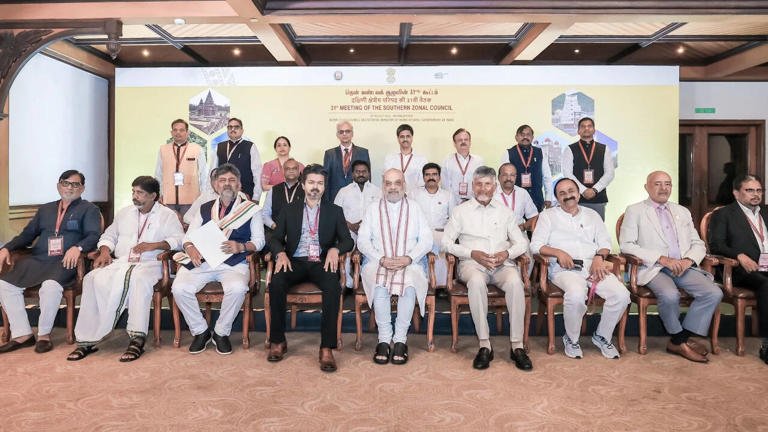
Union Home Minister Amit Shah praised the development and progress of India’s southern states during a meeting with Chief Ministers, highlighting what he described as three important pillars behind their growth. He said the region’s development journey offered valuable lessons for the rest of the country and reflected the importance of strong governance, public participation and effective implementation of development programmes.
Shah discussed the progress made by southern states across several sectors and stressed that development requires a long-term approach. He pointed to the need for cooperation between the Centre and states to ensure that the benefits of growth reach people at every level.
The Union Home Minister’s remarks came during a meeting that brought together Chief Ministers and other senior representatives. The discussion focused on regional development, governance and the role of states in contributing to India’s broader growth story.
According to Shah, the southern states development model has been supported by three key pillars that have helped the region achieve progress in different sectors. He highlighted the importance of these pillars while discussing how governments can build stronger and more inclusive development systems.
Read More: Amit Shah Arrives in Siliguri for 3-Day Bengal Visit, Border Security Events
Amit Shah Highlights Southern States’ Progress
Amit Shah said the southern region has made significant progress and contributed strongly to India’s overall development.
The southern states have developed important strengths in sectors such as education, healthcare, manufacturing, technology and infrastructure. Cities across the region have also emerged as major centres for business and innovation.
Shah highlighted the importance of understanding the factors that have contributed to this growth.
He suggested that development does not depend on a single policy or programme. Instead, it requires several institutions and systems to work together over a long period.
The Union Home Minister also stressed that different regions have different strengths and challenges. However, successful practices can provide useful lessons for other states.
The progress of southern India, therefore, remains important not only for the region but also for India’s larger economic and development goals.
Three Pillars Behind the Region’s Development
During the meeting, Shah identified three key pillars that he linked with the progress of the southern states.
The first pillar is the strong contribution of the region’s people. Human resources and public participation have played an important role in supporting economic and social development.
The second pillar involves effective governance and institutions. Stable administrative systems and the ability to implement policies can help governments deliver services more efficiently.
The third pillar focuses on development-oriented thinking and long-term planning. Investments in areas such as education, infrastructure and economic growth can create benefits over many years.
Together, these pillars can create a strong foundation for sustainable progress.
Shah’s remarks suggested that development requires both government action and public participation.
A strong economy also depends on skilled workers, efficient institutions and long-term investment.
Role of Education and Skilled Human Resources
Education has played an important role in the southern states development story.
The region has several major educational institutions and a large pool of skilled professionals. These factors have supported growth in technology, healthcare, engineering and other sectors.
A skilled workforce can attract businesses and investment.
When companies establish operations in a region, they also create employment and support related industries.
This can create a cycle of growth.
Investment in education can therefore produce long-term economic benefits.
Shah’s focus on human resources highlights the importance of developing skills that match the changing needs of the economy.
As technology continues to transform industries, states will need to invest in training and education.
Young people will require new skills to compete in an increasingly competitive global economy.
Strong Institutions and Effective Governance
Governance formed another important part of the discussion on regional progress.
Government policies can achieve their goals only when authorities implement them effectively.
Strong institutions can improve the delivery of public services and ensure better use of public resources.
The southern states have developed administrative and economic systems that have supported growth in different sectors.
Shah highlighted the importance of effective governance in maintaining this progress.
Transparency, accountability and timely decision-making can help governments respond to the needs of citizens.
The Centre and state governments also need to work together on major development programmes.
India’s federal system requires cooperation between different levels of government.
Meetings involving Chief Ministers can provide a platform for discussing common challenges and sharing successful approaches.
Long-Term Planning and Development
Long-term planning remains essential for sustained growth.
Infrastructure projects, educational reforms and industrial development often take years to produce results.
Governments therefore need to continue policies that support development beyond short-term goals.
The southern states have benefited from investments made over several decades.
Roads, ports, airports, educational institutions and industrial centres can support economic activity for many years.
Technology and manufacturing clusters can also create large numbers of direct and indirect jobs.
Shah’s remarks highlighted the need for other regions to develop their own long-term strategies.
However, each state must adapt its plans according to its geography, resources and population.
There cannot be a single development model for the entire country.
Importance of Centre-State Cooperation
The Chief Ministers’ meeting also underlined the importance of cooperation between the Centre and the states.
India’s economic growth depends on the performance of individual states.
State governments manage several areas that directly affect people’s daily lives, including education, healthcare, agriculture and local infrastructure.
The Centre can support states through national programmes, funding and policy coordination.
At the same time, states need enough flexibility to address their own challenges.
Shah stressed the importance of working together to achieve national development goals.
Cooperative federalism can help governments share resources and learn from each other’s experiences.
Meetings between central and state leaders can strengthen this process.
Southern India as an Economic Growth Centre
Southern India remains an important contributor to India’s economy.
The region includes major centres for information technology, manufacturing, automobiles, electronics and services.
Several cities have attracted national and international companies.
Ports along the southern coastline also support trade and economic activity.
The region’s industrial base creates employment and contributes to India’s exports.
This economic strength has made the southern states important partners in India’s broader development strategy.
Shah’s remarks recognised this contribution while also highlighting the need to continue supporting future growth.
The challenge will be to maintain development while addressing issues such as urban pressure, environmental concerns and changing employment patterns.
Learning From Regional Success
The discussion at the Chief Ministers’ meeting also highlighted the value of sharing successful practices.
Different states have developed innovative approaches to public services and economic development.
One state may perform well in education, while another may develop an effective model for healthcare or industrial growth.
Sharing these experiences can help other governments improve their own programmes.
However, successful ideas must be adapted to local conditions.
A policy that works in one state may require changes before it can succeed elsewhere.
The aim should therefore be to learn from successful experiences without assuming that every region needs to follow the same path.
The southern states development experience can provide useful ideas for policymakers across India.
Challenges for Future Growth
Despite the region’s progress, southern states continue to face several challenges.
Rapid urbanisation has placed pressure on housing, transport and public services.
Cities must continue to improve infrastructure while managing growing populations.
Environmental concerns also require attention.
Climate change, water availability and extreme weather events can affect economic activity and daily life.
The changing nature of employment presents another challenge.
Technology and automation may transform several industries, requiring workers to develop new skills.
Governments will need to prepare young people for these changes.
Continued investment in education, innovation and infrastructure will remain important.
Looking Ahead
Amit Shah’s remarks at the Chief Ministers’ meeting highlighted the important role played by southern India in the country’s development journey.
He pointed to three key pillars behind the region’s progress, including the contribution of people, effective governance and long-term development planning.
The discussion also underlined the importance of education, skilled human resources and strong institutions.
The southern states development experience offers useful lessons, but every state will need to develop strategies based on its own strengths and challenges.
Centre-state cooperation will remain essential as India works towards larger economic and social development goals.
The meeting provided an opportunity for leaders to exchange ideas and discuss the path ahead.
As India continues to pursue rapid growth, the progress of individual states will remain central to the country’s overall success.
Shah’s focus on the three pillars of development highlights the need for a balanced approach that combines strong institutions, public participation and long-term planning to build a more prosperous future.
Read More: Himanta Directs Atul Bora to Coordinate With Meghalaya Over Shillong Violence