


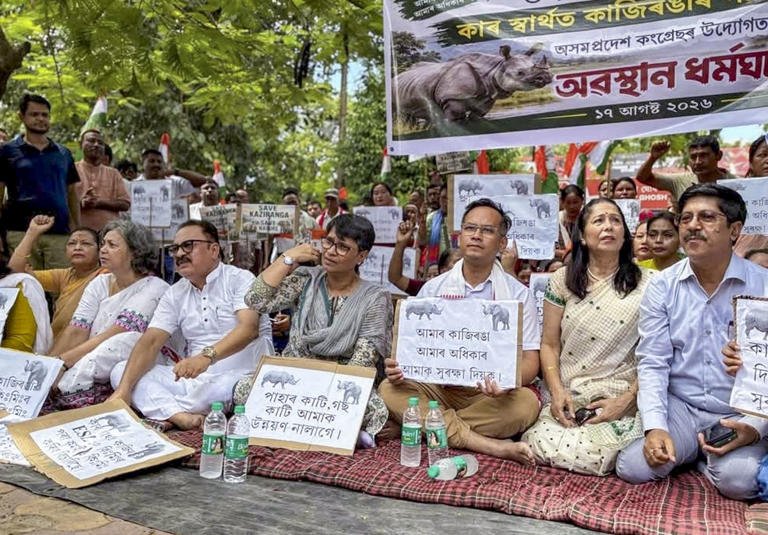
The Assam Congress has announced a statewide march against the proposed reduction of the eco-sensitive zone surrounding Kaziranga National Park. The party has accused the BJP-led government of weakening environmental safeguards around one of India’s most important wildlife habitats.
Congress leaders said the proposed Kaziranga ESZ reduction could threaten forests, wildlife corridors and communities that depend on the region’s fragile ecosystem. The party plans to organise protests across Assam and mobilise public support against the proposal.
Kaziranga National Park is internationally known for its one-horned rhinoceros population. The park also supports elephants, tigers, wild water buffaloes and several other species. Environmental protection around the park has therefore remained a major concern for conservationists and local communities.
Read More: Tejasvi Surya on Gen Z’s Political Rise: CJP a Welcome Move, But Questions Remain
The Congress said it would take the issue to people across the state through a statewide march. Party leaders are expected to highlight the potential environmental impact of reducing the protected buffer around Kaziranga.
Congress announces statewide march in Assam
The Assam Pradesh Congress Committee has decided to launch a statewide campaign against the proposed changes to Kaziranga’s eco-sensitive zone.
Party leaders said the campaign would include marches and public outreach programmes in different districts. Congress workers will seek to create awareness about the importance of maintaining strong environmental protection around Kaziranga National Park.
The party believes that any reduction in the eco-sensitive zone could increase pressure on the wildlife habitat. Development activities near protected areas often require careful planning because they can affect animal movement and natural ecosystems.
Congress leaders said the proposed change has raised serious questions about the future of Kaziranga and its surrounding landscape.
The statewide march will allow the party to raise these concerns directly with residents. It will also focus on the long-term importance of protecting Assam’s forests and wildlife.
Through the campaign, Congress plans to demand that the government reconsider the proposal. The party wants authorities to protect Kaziranga’s existing ecological safeguards.
What is the Kaziranga eco-sensitive zone?
An eco-sensitive zone, or ESZ, acts as a regulated area around a protected wildlife habitat. It aims to reduce the impact of certain activities on national parks and wildlife sanctuaries.
The rules for these zones regulate activities that could damage the environment. They can also guide development near sensitive ecosystems.
Kaziranga National Park has a vast and interconnected landscape. Animals often move beyond the park’s formal boundaries in search of food, water and breeding areas.
Elephants and other wildlife use routes that connect Kaziranga with nearby forests and habitats. A strong eco-sensitive zone can therefore support broader conservation efforts.
Congress leaders argue that reducing the protected area could create new risks for the surrounding ecosystem. They fear that increased development could disturb wildlife corridors and put greater pressure on natural resources.
The party has said that environmental protection must remain a priority when governments plan infrastructure or development projects near sensitive areas.
Congress raises concerns over environmental protection
The opposition party has linked the proposed Kaziranga ESZ reduction with wider concerns about environmental conservation in Assam.
Congress leaders argue that Kaziranga needs stronger protection because of its ecological importance. The park attracts tourists from across India and around the world.
Wildlife tourism also contributes to Assam’s economy. Thousands of people depend directly or indirectly on tourism and related activities.
The party said that protecting the ecosystem would also protect the state’s environmental and economic interests.
Congress plans to use the statewide march to explain these concerns to the public. Leaders and workers are expected to discuss the importance of forests, wetlands and wildlife corridors.
The campaign may also focus on the relationship between environmental protection and the lives of people living near forest areas.
The party has argued that development should not come at the cost of irreversible environmental damage.
Kaziranga remains vital for Assam’s wildlife
Kaziranga National Park occupies a central place in Assam’s conservation landscape. The park has played a major role in protecting the greater one-horned rhinoceros.
Over the years, conservation efforts have helped increase the rhino population. However, wildlife in Kaziranga still faces several challenges.
Floods, habitat loss and human activity can affect animals and their natural movement. During annual floods, many animals move towards higher ground outside the park.
This movement makes the surrounding landscape particularly important. Wildlife needs safe routes to travel between Kaziranga and nearby forested areas.
Conservationists have repeatedly highlighted the importance of protecting these corridors. Roads, settlements and large projects can create obstacles for animals.
The proposed changes to the eco-sensitive zone have therefore triggered political debate. Congress has positioned the issue as a major environmental concern.
Statewide campaign aims to build public awareness
The Congress campaign will seek to take the issue beyond political circles. Party leaders want residents in different parts of Assam to understand the significance of the proposed ESZ changes.
Workers will organise marches and other programmes as part of the campaign. The party hopes to build wider public participation.
The protest will also provide Congress with an opportunity to criticise the state government’s environmental policies.
At the same time, the party plans to present the campaign as a movement to protect Assam’s natural heritage.
Kaziranga remains a symbol of the state’s biodiversity and tourism potential. For many people, the park also represents Assam’s identity on the global stage.
Congress leaders are likely to emphasise these points during the statewide outreach programme.
The party has called for greater transparency in decisions involving environmentally sensitive areas.
Political debate likely to intensify
The proposed Kaziranga ESZ reduction has added another issue to Assam’s political debate.
Congress has taken a strong stand against the proposal and plans to mobilise its organisation across the state.
The ruling government may defend the proposed changes by highlighting development needs and administrative considerations. The debate could therefore centre on how Assam balances conservation with infrastructure and economic growth.
Environmental issues have increasingly become part of political discussions in the state. Assam faces recurring floods, erosion and other ecological challenges.
Kaziranga’s location also makes the surrounding ecosystem particularly sensitive. Decisions involving land use and development near the park often attract close attention.
The Congress march could increase pressure on the government to explain the proposal and address concerns raised by conservation groups and opposition parties.
Congress demands stronger safeguards for Kaziranga
The party has made its position clear: it wants authorities to maintain strong environmental safeguards around Kaziranga.
Congress leaders believe the state must protect the national park and its surrounding ecosystem for future generations.
The proposed statewide march will serve as the party’s main platform to voice that demand. It will also test Congress’s ability to mobilise people around an environmental issue.
As the campaign gathers momentum, the debate over the Kaziranga ESZ reduction is expected to intensify across Assam.
The issue now extends beyond the boundaries of Kaziranga National Park. It has become part of a wider discussion about development, conservation and the future of Assam’s natural resources.
For Congress, the statewide march represents a direct challenge to the proposed reduction. For the government, the controversy could bring renewed scrutiny to its approach towards development near one of India’s most celebrated wildlife landscapes.
The coming weeks may bring greater clarity on the proposed changes and the government’s response. Until then, the Congress plans to continue its campaign and build support for stronger protection around Kaziranga National Park.
Read More: 32-member Kolkata Group Among Many From West Bengal Untraceable After Nepal Disaster