


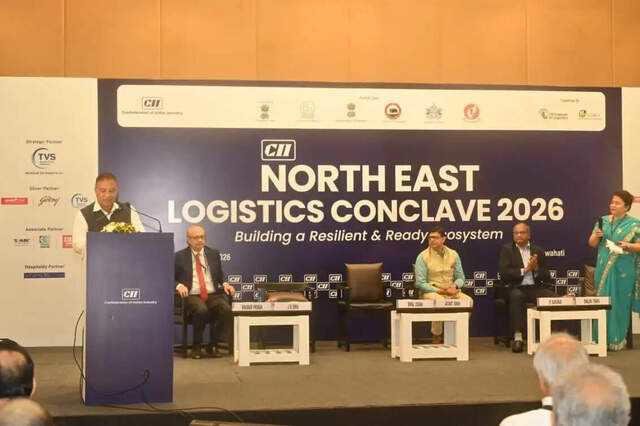
Assam is strengthening its logistics infrastructure to improve trade connectivity across the Northeast and beyond. The state aims to use its location to connect eastern India with neighbouring countries and Southeast Asian markets.
The Assam Logistics and Warehousing Policy, 2025 sets a long-term vision for this transformation. The policy aims to develop Assam as the Northeast’s foremost logistics hub by 2030. It focuses on multimodal connectivity, green infrastructure, efficient supply chains and lower logistics costs.
The strategy links logistics development with Assam’s wider economic ambitions. It also supports the state’s role under India’s Act East Policy.
Strategic Location Supports Trade
Assam occupies a key position in Northeast India. It connects the region with the rest of the country and shares international borders with Bangladesh and Bhutan.
The state also sits close to Myanmar and the wider ASEAN region. This geography gives Assam an important role in cross-border trade.
The state government’s Act East Policy objectives include stronger economic integration with ASEAN and BBIN countries. They also call for seamless road, rail, air and water connectivity.
The logistics policy seeks to build on these geographic advantages. Better transport links can help businesses move goods faster and reduce supply-chain delays.
Multimodal Connectivity at the Centre
Assam’s logistics strategy focuses on connecting different modes of transport.
Roads, railways and inland waterways can work together to move cargo across longer distances. Such integration can reduce dependence on a single transport system.
The state has about 4,077 km of national highways and around 2,571 km of railway network, according to Assam’s investment promotion platform. It also hosts 11 of India’s National Waterways.
National Waterway 2 runs along the Brahmaputra. National Waterway 16 serves the Barak River region. These waterways provide additional options for cargo movement.
The Assam Inland Waterways Company has identified integration with rail and road networks as a key part of its transport strategy.
Jogighopa Logistics Park
The Jogighopa Multimodal Logistics Park is an important part of Assam’s logistics plans.
The facility is designed to integrate road, rail and inland water transport. It can support cargo handling, warehousing and distribution.
Assam’s investment platform describes the project as India’s first multimodal logistics park. The facility is expected to strengthen cargo movement across the Northeast.
The park can also help businesses access wider markets. Producers in Assam and other northeastern states could use integrated transport networks to move agricultural, industrial and manufactured products.
New Cargo Terminals to Expand Network
Rail-linked cargo infrastructure is also expanding in Assam.
Six new Gati Shakti Cargo Terminals are under construction across the state. These include facilities at Baihata, Habaipur, Jogighopa, Kendukona, Basugaon and Chayagaon.
The terminals are expected to strengthen connections between rail, road and waterways. They can also help connect agricultural producers and industries with larger markets.
Such facilities can improve freight handling and reduce the need for multiple transfers between transport modes.
New Highway Projects to Improve Freight Movement
Road connectivity remains another major part of Assam’s logistics plans.
In August 2026, the Union government approved the 135.87-km four-lane Guwahati-Tezpur Corridor. The project will connect Baihata Chariali near Guwahati with Tezpur.
The corridor has an approved capital cost of ₹8,970.20 crore. The government expects it to improve access to economic, social and logistics nodes across Assam and Arunachal Pradesh.
Another major project involves the proposed Gohpur-Numaligarh connectivity corridor. The project includes a 15.79-km road-cum-rail tunnel under the Brahmaputra.
The ₹18,662-crore project will connect important highways, railway lines, airports and inland waterways. The government expects it to improve freight movement and reduce logistics costs across the region.
Waterways Can Support Lower-Cost Transport
Assam’s rivers offer another opportunity for freight movement.
The Brahmaputra and Barak river systems can carry bulk cargo and other goods. Water transport can complement road and rail networks.
The state government has identified the development of multimodal logistics hubs as an important objective. It also plans to modernise inland water transport infrastructure and encourage private participation.
The approach could help move construction materials, agricultural products, petroleum products and containers through waterways.
Focus on Warehousing and Cold Chains
Transport infrastructure alone cannot create an efficient logistics system. Assam’s policy also focuses on modern warehousing and cold-chain facilities.
The 2025 policy aims to integrate Assam with global value chains through modern warehousing, cold chains and transport infrastructure. It also highlights the importance of technology-enabled supply chains.
Better storage facilities can benefit agriculture and food processing industries. Cold chains can help reduce wastage of perishable products.
The state also sees opportunities for technology-enabled warehouses, e-commerce hubs and air cargo facilities in cities such as Dibrugarh and Silchar.
Target to Reduce Logistics Costs
Reducing logistics costs is a central objective of Assam’s 2025 policy.
The policy sets a target of bringing logistics costs below 10 percent of the state’s GSDP by 2030. It links the target with improvements in infrastructure, efficiency and supply-chain management.
Lower logistics costs can make local products more competitive. They can also help industries reach markets outside Assam.
For small businesses and agricultural producers, better logistics can improve access to buyers and distribution networks.
Strengthening Cross-Border Trade
Assam’s logistics plans also have an international dimension.
The state has Integrated Check Posts at Sutarkandi and Darranga. Sutarkandi supports trade with Bangladesh, while Darranga supports connectivity with Bhutan.
The state’s waterways also connect with Indo-Bangladesh Protocol routes. These routes provide access towards Bangladesh’s Mongla and Chattogram ports.
Such links can create additional trade routes for goods from Assam and other northeastern states. They can also strengthen India’s wider connectivity with Bangladesh and Southeast Asia.
Digital Systems and Private Investment
Assam’s logistics policy also emphasises technology and private participation.
The 2025 policy seeks to provide digital single-window services and faster approvals. It also aims to encourage investment in logistics infrastructure.
The government wants private companies to participate in warehouses, logistics parks and other facilities. This approach could expand infrastructure while introducing modern logistics technologies.
Digital tracking and integrated transport management can also improve supply-chain visibility.
Assam’s Long-Term Trade Vision
Assam’s logistics strategy brings together roads, railways, waterways, warehouses and border infrastructure.
The state wants to use its geographic position to strengthen its role as a gateway to the Northeast and neighbouring markets. The Assam Logistics and Warehousing Policy provides a framework for this effort through 2030.
Projects such as the Jogighopa Multimodal Logistics Park, new cargo terminals, major highway corridors and expanded waterways are adding to the state’s transport network.
The broader objective is to make movement of goods faster, more efficient and more cost-effective. If these projects progress as planned, Assam’s logistics network could play a larger role in connecting the Northeast with India’s domestic markets and international trade corridors.