


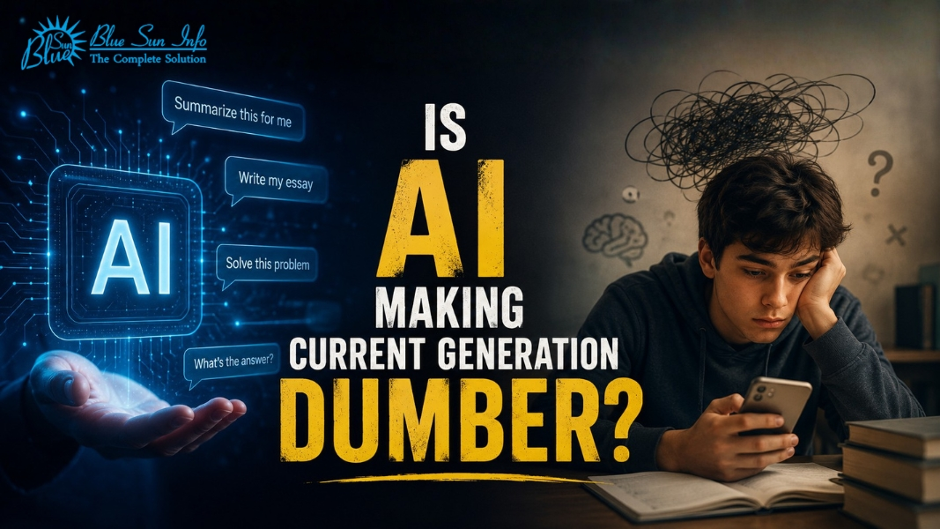
As artificial intelligence becomes deeply integrated into classrooms, workplaces, and everyday life, researchers and educators are increasingly examining its long-term impact on human cognition. While AI tools promise efficiency and enhanced productivity, emerging evidence suggests that over-reliance on these systems may affect how people think, learn, and retain information.
According to a report by Blue Sun Info, a Mumbai-based Web Design, Development, and Digital Solutions company tracking the intersection of artificial intelligence and human behaviour, the findings point to a critical inflection point in how society engages with AI-powered tools.
A Shift in Perception Among Gen Z
Recent findings from Gallup highlight a growing sense of caution among younger users. A March 2026 survey of 1,572 Gen Z respondents aged 14 to 29 found that 42% believe AI could negatively impact their critical thinking abilities, while 38% expressed concerns about its effect on creativity.
These findings align with a 2025 Gallup study of 3,465 young Americans, where respondents were more likely to say AI would harm their critical thinking (42%) than improve it (25%). Gallup noted that while usage of AI tools remains steady, enthusiasm has declined and skepticism is rising, particularly around learning and cognitive development.
Understanding “Cognitive Offloading”
Researchers have long studied the concept of cognitive offloading — the tendency to rely on external tools to perform mental tasks. Studies and discussions from institutions such as MIT Media Lab suggest that while AI can enhance productivity, excessive dependence may reduce active engagement with information, especially in tasks like writing, problem-solving, and analysis.
Similarly, academic research in 2025 examining AI-assisted learning environments found that students using AI tools extensively often showed lower levels of deep engagement, as measured by their interaction with learning material. Experts caution that when AI is used to bypass effortful thinking, it may limit the development of long-term cognitive skills.
Expert Perspectives from Education Leaders
According to discussions published by the Harvard Gazette, educators emphasize that the issue is not AI itself, but how it is used.
Dr. Tina Grotzer, a research scientist in education at Harvard University, noted:
“Teaching students to be critical and discerning about how they use AI is important. But even more important is helping them understand how their human minds work and how powerful they can be when used well.”
Experts warn that tools like auto-complete, content generators, and AI-assisted writing can reduce opportunities for independent thinking if used passively.
Emerging Research and Ongoing Debate
Some early-stage research, including papers published on arXiv, has explored the idea of a widening gap between human attention and AI processing capabilities. While these studies introduce concepts such as increased delegation of thinking tasks to machines, they are still under academic discussion and not yet universally validated.
Researchers broadly agree that the long-term cognitive impact of AI is still evolving, and more peer-reviewed, longitudinal studies are needed to establish definitive conclusions.
The Indian Context
India, with one of the world’s largest youth populations, is rapidly adopting AI technologies across education and daily life. The Ministry of Education India, through the National Education Policy (NEP) 2020, emphasizes critical thinking, problem-solving, and experiential learning as core educational goals.
However, educators in India have raised concerns that unstructured use of AI tools may sometimes encourage shortcut-based learning, where students rely on generated answers instead of understanding underlying concepts.
Awareness vs Behaviour
Interestingly, awareness of AI’s potential downsides does not appear to be reducing its usage. Gallup data indicates that concern about AI’s impact on thinking abilities is rising, even as daily usage remains consistent. This highlights a growing paradox: users recognise the risks, yet continue to depend on the technology.
A Call for Balanced Integration
Experts are increasingly advocating for structured AI literacy, which goes beyond tool usage to include:
- Understanding when and how to use AI
- Maintaining independent thinking skills
- Encouraging deeper cognitive engagement
The focus, researchers argue, should not be on limiting AI adoption, but on ensuring it supports — not replaces — human intelligence.
“Our research reinforces what many educators and technologists have feared — that convenience is quietly coming at the cost of cognitive growth. At Blue Sun Info, we believe the next frontier isn’t just building smarter AI, but ensuring it builds smarter humans.”
— Vijay Bubna, Founder & Managing Director, Blue Sun Info
The Road Ahead
As global investment in AI continues to grow, the conversation is shifting from capability to responsibility. The emerging consensus is clear: AI has the potential to enhance human thinking — but only if it is used consciously and critically.
The challenge ahead lies not in resisting technology, but in preserving the cognitive strengths that define human intelligence in an increasingly automated world.
About Blue Sun Info
Blue Sun Info is a Mumbai-based Web Design, Development, and Digital Solutions company dedicated to delivering top-notch quality across web hosting, mobile app development, search engine optimisation (SEO), and web design and development. With a unique blend of technical expertise and creative intelligence, Blue Sun Info partners with businesses to build a powerful and distinctive digital presence. The company is committed to responsible AI integration — ensuring technology serves as a tool for human empowerment, not a replacement for human thinking.
For more information, visit www.bluesuninfo.com