


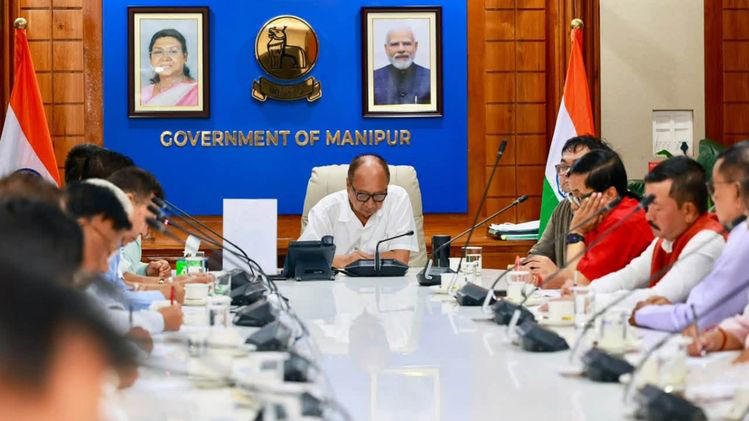
An all-party meeting in Manipur has brought political parties and civil society representatives together over the proposed updating of the National Register of Citizens (NRC) in the state. Chief Minister Y Khemchand Singh chaired the meeting at the Chief Minister’s Secretariat, where participants discussed issues linked to citizenship verification, indigenous identity, security and the future of Manipur.
The meeting assumes significance as demands for an updated NRC have grown stronger in recent months. Political representatives from different parties, including the BJP and Congress, along with civil society organisations, participated in the discussions. The meeting reportedly concluded on a positive note after the Chief Minister heard concerns and suggestions from representatives.
Protecting Manipur’s Indigenous Identity
The central issue discussed during the meeting was the protection of Manipur’s indigenous identity. Supporters of the NRC update argue that establishing a verified record of citizens is important for protecting the state’s demographic balance and ensuring that indigenous communities are not disadvantaged by undocumented migration.
Manipur shares an international border with Myanmar, and concerns about cross-border movement and demographic changes have remained politically sensitive. Civil society organisations have repeatedly demanded that the NRC be updated before the Census, arguing that population data should be based on verified citizenship records.
The demand has also gained support across political lines, making the issue one of growing importance in the state’s political discourse.
Why the 1951 Baseline Matters
One of the most important aspects of Manipur’s NRC debate is the proposed use of 1951 as the baseline year. The state government has indicated that it wants to use historical records from that period while preparing the framework for the NRC update.
The proposed 1951 baseline distinguishes Manipur’s approach from Assam’s NRC exercise, which used March 24, 1971, as its cut-off date. The choice of a baseline is particularly sensitive because it can determine which historical documents and records are considered relevant for establishing citizenship.
However, an NRC exercise would require approval and cooperation from the Centre and would have to operate within the constitutional and legal framework.
NRC Demand Ahead of the Census
The NRC issue has become closely connected with the upcoming Census. Manipur’s Legislative Assembly recently reaffirmed its demand that the NRC be updated before the Census is conducted in the state.
Civil society organisations have also organised rallies and public campaigns calling for the NRC to precede the Census. Their argument is that conducting population enumeration without first addressing citizenship-related concerns could create uncertainty over demographic data and potentially affect future political processes, including delimitation.
The Centre has already deferred the Census house-listing exercise in Manipur following consultations over the demand for an NRC-first approach.
Political Consensus and the Road Ahead
The latest all-party meeting indicates an attempt to build wider political consensus around a highly sensitive issue. Bringing together representatives from different political parties and civil society groups could help the state develop a more broadly accepted approach to citizenship verification.
At the same time, the implementation of an NRC would involve significant administrative and legal challenges. Ensuring accurate records, protecting genuine citizens from wrongful exclusion and creating a transparent verification mechanism would be essential to maintaining public confidence.
For Manipur, the NRC debate is therefore about more than documentation. Supporters view it as a mechanism to safeguard indigenous identity, security and political interests amid concerns over demographic change. The coming months will determine how the state and Centre translate the emerging political consensus into a legally sound and inclusive process.
The all-party meeting has nevertheless marked an important step: the demand for updating the NRC is no longer confined to civil society campaigns but has become a major issue receiving attention across Manipur’s political spectrum.
Read More: Lumsey Jan Sewa Bhawan set for major public service boost in Sikkim