


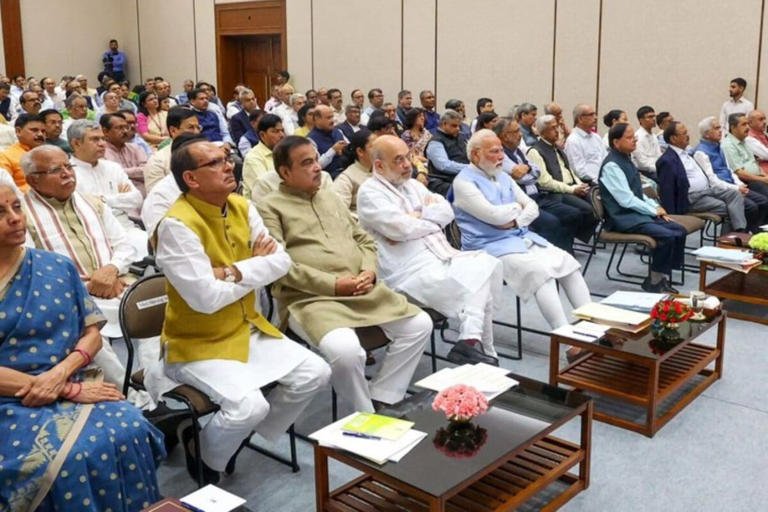
In a first-of-its-kind administrative exercise, the Centre assessed ministries and departments through a structured performance review and presented internal “report cards” during a Council of Ministers meeting chaired by Prime Minister Narendra Modi on Thursday. The exercise focused on strengthening accountability, improving administrative efficiency, and encouraging faster decision-making across government departments.
Cabinet Secretary T. V. Somanathan presented the rankings during the meeting and evaluated ministries on key governance indicators, including disposal of files, handling of public grievances, and timely responses to Cabinet notes.
According to reports, the review aimed to create a more responsive administrative culture and push ministries toward quicker execution and improved public service delivery.
Read More: Guwahati’s New Flyover Honours Syama Prasad Mookerjee’s Legacy in Assam
Centre Introduces Administrative Performance Assessment
The performance review marked a new approach in evaluating ministries and departments on operational efficiency rather than broad policy outcomes alone.
According to reports, ministries were assessed separately across different administrative indicators instead of receiving a combined overall ranking. The exercise covered performance during 2025 and focused on measurable governance-related parameters.
The review examined how quickly ministries processed files, responded to public concerns, and coordinated decision-making procedures.
Officials indicated that the assessment intended to improve internal accountability and encourage ministries to strengthen execution standards.
The initiative also reflected a wider effort to promote efficiency and reduce delays across administrative systems.
By introducing performance-based reviews, the government aims to encourage stronger institutional responsiveness.
PM Modi Calls for Faster Decision-Making
During the Council of Ministers meeting, Prime Minister Narendra Modi reportedly emphasised the importance of quicker decisions and efficient governance.
According to reports, the Prime Minister instructed ministers and officials to accelerate administrative action and prioritise public welfare outcomes.
An official quoted in reports stated that the Prime Minister stressed there should be no room for unnecessary delays or administrative lethargy when decisions affect public interests.
The discussion reportedly focused on improving execution capacity and strengthening accountability across departments.
Government systems often depend on timely coordination and faster implementation. Therefore, the emphasis remained on ensuring that decisions translate into visible outcomes.
The message also highlighted the importance of maintaining administrative momentum across ministries.
Key Parameters Included File Disposal and Grievance Handling
The evaluation framework reportedly measured ministries across several administrative categories.
Among the major indicators were disposal of files, grievance redressal performance, and responsiveness to Cabinet notes.
File movement and decision timelines remain important because delays can affect policy execution and service delivery.
Similarly, grievance resolution reflects how efficiently ministries respond to concerns raised by citizens and stakeholders.
Cabinet note management also plays an important role in maintaining coordination across government functions.
Officials indicated that evaluating these indicators can help identify areas requiring operational improvement and stronger administrative practices.
The review placed emphasis on measurable outcomes and procedural effectiveness.
Consumer Affairs, Coal, Power and Health Ministries Perform Strongly
Reports suggested that several ministries performed strongly across the assessed categories.
According to media reports, the consumer affairs ministry emerged as one of the strongest performers in grievance resolution and in handling issues connected to the West Asia conflict.
The coal ministry reportedly received high ratings for file disposal and administrative management.
Meanwhile, the power and health ministries also ranked among the better-performing departments during the assessment exercise.
These ministries demonstrated stronger outcomes across individual performance indicators reviewed during the evaluation.
However, reports clarified that authorities did not create a combined ranking that declared an overall top ministry.
Instead, departments received separate assessments depending on individual administrative categories.
Exercise Aims to Improve Accountability Across Ministries
Government officials reportedly viewed the exercise as an opportunity to strengthen institutional accountability and improve administrative culture.
Performance measurement systems can create stronger monitoring mechanisms and encourage departments to adopt efficient working practices.
Supporters of administrative reviews argue that regular assessments can reduce delays and improve implementation standards.
The initiative also reflects growing attention toward governance quality and public service delivery.
Officials indicated that evaluating ministries through practical indicators can encourage departments to identify bottlenecks and improve internal processes.
Administrative efficiency continues to remain an important component of governance reform efforts.
The review framework may also support future improvements in operational performance.
Governance Focus Shifts Toward Outcomes and Efficiency
The ministry report card exercise reflects a broader governance trend that places greater focus on outcomes, implementation, and measurable performance.
Administrative reforms increasingly emphasise execution capacity alongside policy announcements.
Governments often rely on monitoring systems to strengthen coordination and improve responsiveness.
By reviewing ministries against operational indicators, authorities seek to encourage timely action and stronger delivery standards.
Observers noted that such exercises can help create greater institutional discipline and improve public confidence in governance systems.
At the same time, sustained implementation remains important to ensure that evaluations lead to practical improvements.
The emphasis on performance tracking signals a growing focus on governance efficiency.
Review Highlights Push for Faster Public Service Delivery
The Council of Ministers meeting placed attention on how ministries function internally and how administrative performance influences governance outcomes.
Through the report card exercise, the government has attempted to introduce greater accountability and strengthen decision-making processes.
Officials expect such reviews to encourage ministries to maintain higher standards of responsiveness and execution.
The initiative also underlines the importance of reducing delays and ensuring smoother public service delivery.
As ministries continue adapting to performance-based monitoring, administrative efficiency is likely to remain an important area of focus.
The ministries report cards PM Modi meeting reflects a governance approach that prioritises accountability, faster decisions, and improved institutional performance across departments.
Read More: Former JD(U) Leader Nimaichand Luwang Joins BJP in Manipur