


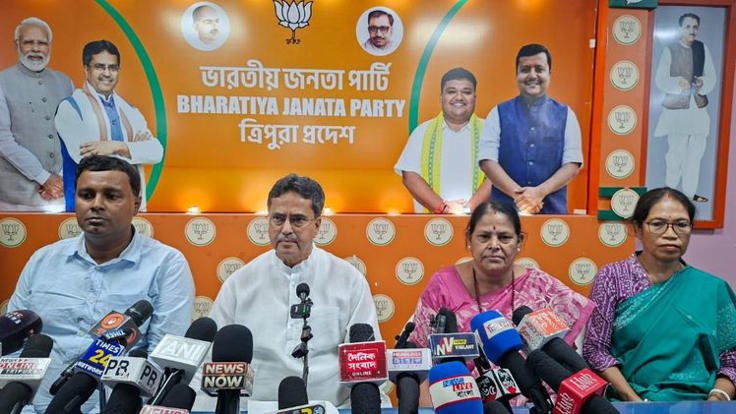
Tripura Chief Minister Manik Saha has accused opposition parties of blaming Electronic Voting Machines (EVMs) and the Election Commission of India (ECI) whenever they lose elections or fail to receive public support.
Saha made the remarks during a press conference in Agartala on September 28. His comments came amid an escalating political debate over the Election Commission, the Special Intensive Revision (SIR) of electoral rolls and reports about differences among members of the poll panel.
The Chief Minister defended the Election Commission and said political parties should not undermine public confidence in constitutional institutions after unfavourable election results.
Read More: Arunachal Pradesh Conducts First Kidney Transplant at TRIHMS, CM Pema Khandu Says
Saha says criticism follows electoral defeats
Saha alleged that questioning EVMs and the Election Commission had become a recurring response from opposition parties after election defeats.
He referred to elections in West Bengal and Kerala to support his argument. According to Saha, opposition parties raised concerns about the Election Commission in situations where they lost, while similar criticism did not emerge when they secured electoral victories.
“Whenever opposition parties lose elections or do not get the support of the people, they blame the EVMs or the Election Commission,” Saha said, according to reports.
He argued that political parties should examine election results and institutional procedures before making allegations against constitutional bodies.
Chief Minister addresses concerns over SIR
Saha’s comments also focused on the ongoing Special Intensive Revision of electoral rolls.
The SIR exercise has become a major political issue, with opposition parties raising concerns about voter-list revisions and the exclusion of names from electoral rolls. The Election Commission has defended the process and said it aims to create accurate and transparent voter lists.
Saha said the Commission’s decision to conduct the SIR received the approval of all three Election Commissioners. He referred to the ECI’s September 26 clarification, which stated that the nationwide SIR order had received unanimous approval.
The Chief Minister argued that this showed the process involved collective decision-making rather than the decision of one individual.
Differences within EC should not threaten democracy
Saha also addressed reports about differences of opinion among Election Commission members.
He said discussions and disagreements within a constitutional institution do not automatically indicate a threat to democracy. According to him, members of an institution can hold different views before reaching a final decision.
The Election Commission has also rejected reports suggesting that its SIR decisions reflected a formal institutional split. In its September 26 statement, the poll panel said decisions related to the SIR had received unanimous approval from all three commissioners.
Saha said democratic institutions can accommodate internal discussions while still reaching collective decisions.
Opposition has raised wider concerns over ECI
The Chief Minister’s remarks come against the backdrop of growing opposition criticism of the Election Commission.
Opposition parties have questioned the SIR process and raised concerns about voter deletions, electoral-roll verification and the functioning of the poll panel. Recent reports have also highlighted disagreements among election commissioners over certain decisions linked to voter-roll processes.
The Election Commission has rejected allegations of politically motivated action. It has maintained that electoral-roll revisions follow established legal procedures.
The controversy has intensified as several political parties demand greater transparency in the functioning of the poll panel.
Saha cites West Bengal and Kerala elections
Saha cited the 2026 West Bengal and Kerala Assembly elections while challenging what he described as selective criticism of the Election Commission.
He referred to constituencies in West Bengal where voter names had been removed during electoral-roll revision. Saha argued that the subsequent election results did not support the idea that the revision automatically benefited one political party.
He also pointed to Kerala, where the Congress-led United Democratic Front won 97 seats in the 2026 Assembly election. Saha argued that if concerns about the Election Commission were based simply on election outcomes, similar questions could have arisen after an election won by opposition parties.
His argument was that political parties should apply the same standards to electoral institutions regardless of whether election results favour them.
Saha says he is defending public trust
Saha clarified that he was not speaking on behalf of the Election Commission. Instead, he said he was responding politically to what he described as allegations against a constitutional institution.
He stressed the importance of maintaining public confidence in India’s electoral system. According to him, repeated allegations against the ECI without adequate evidence could affect people’s trust in democratic institutions.
Saha maintained that the Election Commission was functioning in a systematic manner and according to the law.
ECI controversy continues amid SIR debate
The dispute over the Election Commission has now become part of a wider political debate about electoral transparency and voter-list revision.
The ECI has defended its SIR process, while opposition parties continue to question aspects of voter verification and electoral-roll changes. The Commission has also announced additional measures to assist voters facing issues during the revision process.
Against this backdrop, Manik Saha’s comments represent the BJP’s defence of the Election Commission and its procedures. His criticism of the opposition has added to the political exchange surrounding EVMs, voter rolls and the SIR exercise.
The debate is likely to continue as authorities process electoral-roll revisions and political parties maintain their respective positions on the functioning of the Election Commission.