


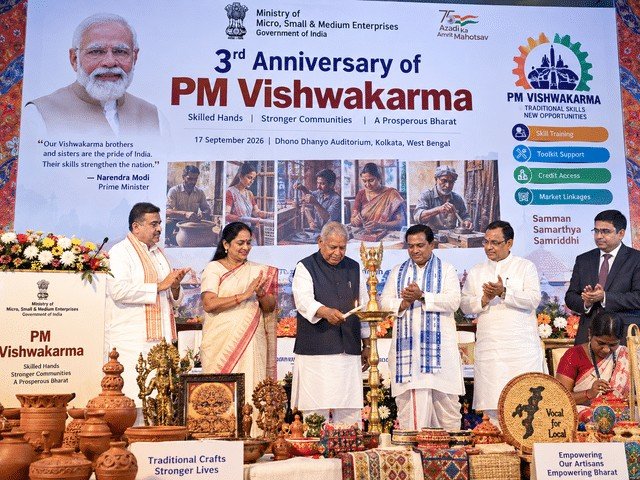
The PM Vishwakarma scheme has completed three years with 30 lakh traditional artisans and craftspeople registered across India. The Ministry of Micro, Small and Medium Enterprises (MSME) marked the third anniversary with a special event at the Dhono Dhanyo Auditorium in Kolkata on September 17.
The government launched PM Vishwakarma on September 17, 2023. The scheme supports traditional artisans who work with their hands and tools across 18 identified trades. It provides a combination of skill training, modern toolkits, institutional credit and market support.
Union MSME Minister Jitan Ram Manjhi attended the Kolkata event along with West Bengal Chief Minister Suvendu Adhikari and Union Minister of State for MSME Shobha Karandlaje.
The anniversary event highlighted the progress of the scheme and showcased the traditional skills and products of Vishwakarma artisans.
30 Lakh Artisans Registered Under the Scheme
The PM Vishwakarma scheme has reached its registration target of 30 lakh beneficiaries. According to the MSME Ministry, around 24.50 lakh Vishwakarmas have completed basic skill training under the programme.
The scheme aims to strengthen traditional occupations by combining formal recognition with training and financial assistance. Beneficiaries receive a PM Vishwakarma Certificate and ID card after completing the registration and verification process.
The government also provides training to help artisans adopt improved techniques and modern tools. Basic training generally lasts five to seven days, while advanced training continues for 15 days or more. Trainees receive a stipend of ₹500 per day during training.
This training component seeks to help traditional workers improve the quality and productivity of their products.
Modern Toolkits Delivered to Artisans
Modern equipment forms another important part of PM Vishwakarma. The government has delivered 18.15 lakh modern toolkits to beneficiaries through India Post, according to the MSME Ministry.
The scheme provides a toolkit incentive of up to ₹15,000 through e-vouchers. Artisans can use the support to obtain improved tools relevant to their traditional trades.
Better tools can help artisans improve production and product quality. They can also help workers adapt traditional skills to changing market requirements.
The scheme therefore combines traditional knowledge with modern equipment. The government has presented this approach as a way to strengthen the long-term sustainability of traditional occupations.
Credit Support Reaches Thousands of Vishwakarmas
PM Vishwakarma also provides concessional credit to eligible beneficiaries. So far, 6.18 lakh Vishwakarmas have received loans of up to ₹1 lakh, with the loans carrying a concessional interest rate of 5% per year.
The loans sanctioned under this component have reached ₹5,297 crore, according to the MSME Ministry.
The broader credit component provides enterprise development loans in two stages. Beneficiaries can access a first tranche of ₹1 lakh and a second tranche of ₹2 lakh, subject to the scheme’s eligibility and repayment conditions.
Access to institutional credit can help artisans invest in tools, raw materials and business expansion.
Kolkata Hosts Third Anniversary Celebration
The Ministry of MSME organised the third anniversary celebration at the Dhono Dhanyo Auditorium in Kolkata. The event also featured an exhibition of traditional arts and crafts created by Vishwakarma artisans.
Union Minister Jitan Ram Manjhi, Union Minister of State Shobha Karandlaje, West Bengal MSME and Textiles Minister Dipak Barman and Minister of State for MSME and Textiles Ashoke Dinda inaugurated the exhibition.
The exhibition provided artisans from West Bengal with a platform to display their traditional products and craftsmanship.
The event also included the distribution of PM Vishwakarma certificates, basic skill-training certificates, toolkits and loan-related documents to beneficiaries.
More than 2,000 Vishwakarmas and Panchayat functionaries from across West Bengal participated in the celebrations.
West Bengal Joins the PM Vishwakarma Scheme
West Bengal joined the implementation of PM Vishwakarma in May 2026. The move expanded the scheme’s reach among traditional artisans and craftspeople in the state.
The state has since received more than seven lakh applications under the scheme, according to statements made during the anniversary programme. The government has also started the process of verification and skill training for eligible applicants.
The Union government had earlier reported that 3,000 beneficiaries in West Bengal had successfully completed the three-stage verification process. Skill training had also started for registered beneficiaries.
The Kolkata event therefore served as an important platform for highlighting the scheme’s expansion in West Bengal.
Exhibition Highlights Traditional Craftsmanship
Traditional skills formed a major part of the anniversary programme. The exhibition allowed artisans to present products linked to their respective trades.
PM Vishwakarma covers 18 traditional occupations. These include carpenters, blacksmiths, goldsmiths, potters, sculptors, masons, cobblers, tailors, basket and mat makers, barbers and other traditional workers.
Many of these occupations rely on skills passed down through families and communities. The scheme seeks to support this traditional knowledge while helping artisans access modern business opportunities.
The government also aims to connect beneficiaries with wider markets. Market support includes opportunities through platforms such as the Government e-Marketplace, e-commerce channels, trade fairs and exhibitions.
Focus on Women Entrepreneurs
Union Minister of State for MSME Shobha Karandlaje highlighted the importance of supporting women entrepreneurs during the anniversary celebrations.
She encouraged beneficiaries to make full use of the opportunities available under the scheme. Her remarks also focused on the role of women in strengthening families and local communities through entrepreneurship.
Women form a significant part of India’s informal and traditional economic activities. Better access to training, tools, credit and markets can help women expand their existing enterprises.
The scheme’s support therefore extends beyond individual artisans. It also has implications for household incomes and local economic activity.
Scheme Aims to Strengthen Traditional Livelihoods
PM Vishwakarma follows an integrated approach to supporting artisans. Instead of focusing on only one form of assistance, the scheme combines recognition, training, toolkits, credit, digital incentives and market support.
The government has described these areas through three broad pillars: Samman, Samarthya and Samriddhi. The approach seeks to recognise traditional artisans, strengthen their capabilities and create opportunities for greater economic prosperity.
The scheme also seeks to strengthen the traditional Guru-Shishya parampara, through which artisans pass their skills to younger generations.
Such support could help traditional occupations remain viable while artisans adapt to modern markets and changing consumer demand.
Three-Year Milestone Marks Wider Artisan Support
The third anniversary of PM Vishwakarma marks a significant milestone in the government’s programme for traditional artisans. The registration of 30 lakh beneficiaries has been accompanied by large-scale skill training, toolkit distribution and credit support.
With 24.50 lakh artisans receiving basic skill training and 18.15 lakh modern toolkits delivered, the scheme has expanded beyond registration into training and enterprise support.
The Kolkata celebration also brought attention to the artisans themselves. Through exhibitions, certificates, toolkits and credit support, the event showcased the different forms of assistance available under PM Vishwakarma.
As the scheme enters its fourth year, its focus will remain on helping traditional artisans improve their skills, access finance, use modern tools and connect with wider markets. The Kolkata anniversary event highlighted these objectives while placing India’s traditional craftsmanship at the centre of a national programme for artisan support.