


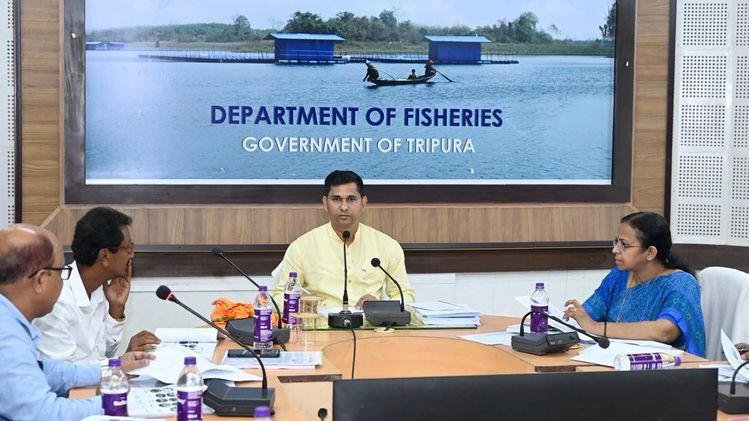
Tripura has achieved a major milestone in its fisheries sector, with fish production crossing 94,000 metric tonnes (MT), reflecting steady growth in one of the state’s most important agricultural and livelihood sectors. The achievement was highlighted during a review meeting where officials assessed the progress made in fish production, discussed ongoing development initiatives, and examined challenges that continue to affect the sector.
Read More: Assam CM Himanta Biswa Sarma Discusses Northeast Development Roadmap at Shillong Conference
The fisheries sector plays a crucial role in Tripura’s rural economy. It supports thousands of farmers, generates employment, and contributes significantly to food security. With fish being a staple part of the diet for many people in the state, increasing domestic production has remained a key objective of government policy.
Officials noted that the growth in fish production demonstrates the effectiveness of various initiatives aimed at improving aquaculture practices, expanding fish farming activities, and supporting fish farmers through training, infrastructure development, and financial assistance. However, they also emphasized the need to address several challenges to ensure sustainable growth in the years ahead.
Fish Production Continues Upward Trend
The crossing of the 94,000 MT mark represents a significant achievement for Tripura’s fisheries sector. Over the years, the state has taken several steps to increase fish production and reduce dependence on imports from neighboring states.
Government programmes have encouraged farmers to adopt scientific fish farming methods, improve pond management practices, and utilize better-quality fish seed. These measures have helped increase productivity and improve overall output.
Officials stated that fish farming has become an increasingly attractive livelihood option for rural households due to its income-generating potential and relatively low land requirements. As a result, more farmers have entered the sector, contributing to the steady rise in production.
The state’s efforts have also focused on increasing the utilization of available water bodies, including ponds, reservoirs, and community fisheries resources. Better management of these resources has played a key role in boosting production levels.
Fisheries Remain Vital for Rural Livelihoods
The fisheries sector is an important source of livelihood for thousands of families across Tripura. Fish farming provides direct employment to farmers while also creating opportunities in related activities such as fish seed production, transportation, marketing, and processing.
Officials highlighted that the growth of the sector has contributed to rural income generation and economic development. Many small and marginal farmers have adopted aquaculture as a supplementary source of income, helping improve household earnings and financial stability.
Women also play a significant role in fisheries-related activities, particularly in fish processing, marketing, and small-scale aquaculture operations. As the sector expands, it continues to create opportunities for greater community participation and economic inclusion.
The government views fisheries development as an important tool for improving rural livelihoods and promoting sustainable economic growth in the state.
Government Support Boosting Productivity
State authorities have implemented several programmes aimed at strengthening the fisheries sector and increasing production. These initiatives include financial assistance for pond construction and renovation, distribution of fish seed, training programmes, and technical support for farmers.
Officials noted that access to modern aquaculture techniques has helped farmers improve productivity and achieve better yields. Scientific fish farming practices, including proper feeding, water quality management, and disease control, have become increasingly important in enhancing production levels.
The government has also focused on capacity-building initiatives that equip farmers with the knowledge and skills needed to adopt improved technologies. Training programmes conducted by fisheries experts have helped farmers understand best practices and address common challenges.
Such interventions have contributed significantly to the sector’s growth and have strengthened the confidence of fish farmers across the state.
Growing Demand Encourages Expansion
The demand for fish continues to rise in Tripura due to population growth, changing dietary preferences, and increasing awareness of the nutritional benefits of fish consumption. Meeting this demand through local production remains a major objective for the state government.
Officials pointed out that increasing domestic production helps reduce dependence on fish imports while ensuring a stable supply for consumers. Higher local production can also help stabilize prices and improve market efficiency.
The growing market demand has encouraged farmers to expand fish farming activities and invest in productivity improvements. Many producers are exploring new techniques and species to maximize returns and meet consumer preferences.
The fisheries department believes that continued growth in demand will create additional opportunities for farmers and entrepreneurs involved in the sector.
Infrastructure Development Supporting Growth
Infrastructure development has emerged as a critical component of fisheries expansion in Tripura. Officials noted that investments in hatcheries, fish seed production centers, storage facilities, and transportation networks have helped improve the efficiency of the fisheries value chain.
Quality fish seed is essential for maintaining productivity and ensuring healthy fish growth. The government has been working to strengthen hatchery infrastructure and increase the availability of quality seed to farmers across the state.
Cold storage and transportation facilities are equally important for reducing post-harvest losses and maintaining product quality. Improved infrastructure enables fish farmers to access larger markets and secure better prices for their produce.
Officials emphasized that continued investments in fisheries infrastructure will be necessary to support future growth and strengthen the sector’s competitiveness.
Challenges Continue to Affect the Sector
Despite the impressive growth in fish production, officials acknowledged that several challenges continue to affect the fisheries sector. These include limited availability of quality fish seed in certain areas, rising input costs, disease management issues, and climate-related risks.
Changing weather patterns and extreme climatic events can impact water availability and fish health, creating uncertainties for farmers. Addressing these challenges requires effective planning, technical support, and investment in climate-resilient practices.
Another concern is the need for greater adoption of advanced aquaculture technologies. While many farmers have embraced scientific practices, there remains scope for further modernization and productivity enhancement.
Officials also highlighted the importance of strengthening marketing systems and improving access to financial services to support the long-term growth of the sector.
Focus on Self-Sufficiency in Fish Production
Tripura has been working toward achieving self-sufficiency in fish production, and the latest figures indicate steady progress toward that goal. Reducing dependence on external supplies remains a priority, particularly given the state’s strong demand for fish.
Officials believe that continued support for farmers, combined with investments in infrastructure and technology, can help bridge any remaining production gaps. Increasing productivity while maintaining sustainability will be critical for achieving long-term self-reliance.
The government is also exploring ways to promote integrated farming systems that combine fisheries with agriculture and livestock activities. Such approaches can improve resource utilization and enhance farm incomes.
Efforts to strengthen local production are expected to contribute not only to food security but also to broader economic development.
Future Roadmap for Fisheries Development
During the review meeting, officials discussed strategies for sustaining growth and addressing existing challenges. The focus will remain on improving productivity, expanding infrastructure, enhancing training programmes, and encouraging innovation in the sector.
Authorities emphasized the need for stronger collaboration among government agencies, research institutions, and farmers to promote knowledge sharing and technology adoption. Continued investment in capacity building will also play an important role in supporting future growth.
The state plans to strengthen fish seed production, improve disease management systems, and promote sustainable aquaculture practices. These measures are expected to help increase production while protecting environmental resources.
Positive Outlook for the Sector
The achievement of more than 94,000 MT of fish production highlights the steady progress made by Tripura’s fisheries sector. It reflects the combined efforts of farmers, government agencies, and stakeholders who have worked to strengthen aquaculture and improve productivity.
While challenges remain, the sector’s growth demonstrates its potential to contribute significantly to food security, employment generation, and rural development. Continued support, innovation, and investment will be essential for maintaining this momentum.
As Tripura moves forward with its fisheries development agenda, the sector is expected to play an increasingly important role in the state’s economy. With the right policies and sustained efforts, fish production can continue to rise, creating new opportunities for farmers and helping the state move closer to its goal of self-sufficiency.
Read More: Indian Army Repatriates Pakistani Youth Who Inadvertently Crossed LoC in Kashmir’s Kupwara