


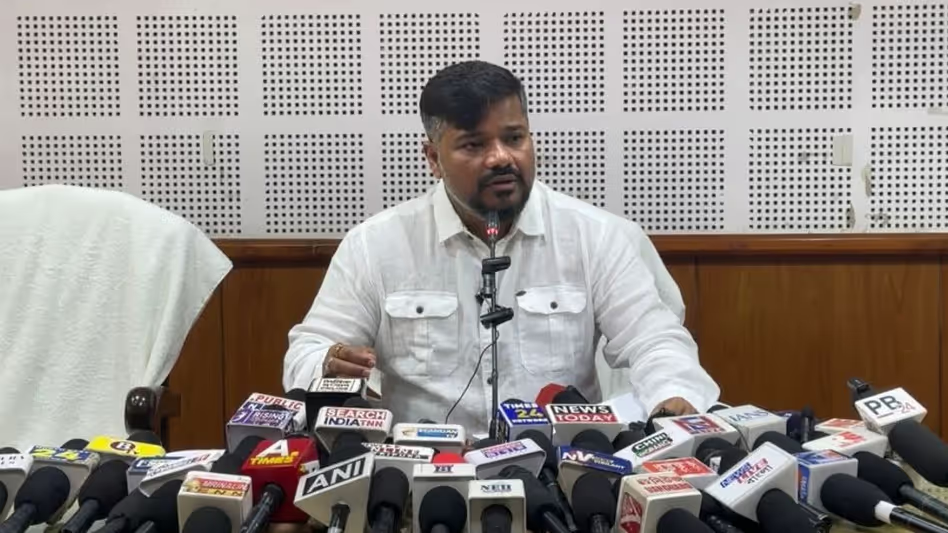
A Wage Dispute Sparks Questions over the functioning of Tripura University after a Regional Labour Commissioner ordered payment of ₹45.13 lakh to 68 outsourced workers. The order concerns alleged shortfalls in minimum wages and overtime payments during April 2025 to April 2026. It has also renewed scrutiny of administrative decisions taken during the tenure of former Registrar Dr. Deepak Sharma.
Wage Dispute Sparks Questions Over Outsourced Workers’ Payments
The Regional Labour Commissioner (Central), Guwahati, passed the order on August 31, 2026, in a case filed by Debabrata Biswas and other workers. The proceedings were registered under Section 20(2) of the Minimum Wages Act, 1948. The workers had alleged that outsourced employees at Tripura University received less than the minimum wages applicable under the relevant Central Government notification.
The claim covered 68 workers and initially included ₹35,40,732 as the alleged difference in minimum wages. The applicants also claimed ₹4,74,096 in overtime wages. After examining the submissions and worker-wise calculations, the Labour Commissioner determined the total amount payable, including compensation, at ₹45,13,282.
Consequently, the dispute has moved beyond an internal employment disagreement. The Labour Authority has directed the university to pay the awarded amount directly into the bank accounts of the concerned workers within 30 days of receiving the order. The university must also submit payment records and transaction details to the workers and the Labour Authority.
The order therefore places the university’s outsourcing and wage-monitoring arrangements under renewed attention. Moreover, the case raises questions about how wage obligations were communicated between the university and its contractors and how compliance with statutory requirements was monitored.
Labour Order Records Competing Positions
The case involved different positions from the workers, the contractor and the university. The workers maintained that they had not received the minimum wages applicable to their employment during the relevant period.
Meanwhile, M/s S Basu Thakur & Co., the contractor named in the proceedings, argued that it had made payments according to the rates notified by the Tripura Government under the terms of its university contract. The contractor also referred to correspondence with the university concerning an enhancement of wages for outsourced employees in line with Central Government rates.
According to the Labour Authority’s account, the contractor indicated that it would make the higher payments if the university provided the necessary funds. Therefore, the dispute involved not only the workers’ wage claims but also questions about the contractual and administrative arrangements governing outsourced employment.
The university participated in the proceedings through its representatives. Deputy Registrar Muneendra Mishra and Professor Priya Ranjan Kumar appeared on behalf of Tripura University, with advocate P.P. Chakraborty also representing the university side.
After considering the documents and submissions, the Labour Commissioner concluded that the workers were entitled to the wages and compensation determined in the order. The authority also recorded that delayed payment had caused financial hardship and monetary loss to the affected workers.
Furthermore, the order contains detailed calculations covering skilled, semi-skilled and unskilled categories. This worker-wise assessment formed the basis for the final award of ₹45.13 lakh.
The distinction between the parties’ positions remains important. The contractor’s explanation and the Labour Commissioner’s final determination should not be treated as the same thing. Instead, the order represents the authority’s conclusion after examining the claim and material placed before it.
Deepak Sharma’s Tenure Faces Renewed Scrutiny
The wage order has also brought renewed attention to the administrative period associated with former Tripura University Registrar Dr. Deepak Sharma. Tripura University’s own records identify Sharma as Registrar, while the university’s current official information lists Prof. Ganga Prasad Prasain as Vice-Chancellor.
The distinction matters because the wage proceedings themselves concern the university as an institutional employer and the contractor responsible for outsourced workers. The Labour Commissioner’s order does not, in the material reviewed here, establish personal liability against Sharma.
However, the controversy has prompted wider questions about how outsourcing arrangements were administered during the relevant period. The Labour order records that the contractor had communicated with the university about enhancing wages in accordance with Central Government rates. That correspondence has consequently become an important part of the broader administrative discussion.
Earlier in 2026, Tripura University also cancelled an office order concerning the engagement of four Daily Rated Workers. A January report from TripuraInfo said the cancellation triggered questions about appointments and administrative practices during Sharma’s tenure. Those reports contained allegations of irregularities, but the allegations were not established as findings against Sharma in the sources reviewed.
Similarly, other reports published earlier in 2026 raised allegations concerning recruitment, appointments and financial administration at the university. These claims should remain clearly attributed because they involve contested matters and do not by themselves establish misconduct.
Therefore, the latest wage order adds a documented labour-law proceeding to a wider period of administrative scrutiny. It does not, by itself, prove that any individual university official committed wrongdoing.
₹45.13 Lakh Order Raises Accountability Questions
The Wage Dispute Sparks Questions development also highlights the importance of institutional accountability when universities outsource essential services. Outsourced workers can perform a wide range of support functions, making timely and lawful wage payments an important part of university administration.
The Labour Commissioner’s decision indicates that the authority found a wage difference and compensation payable to the affected workers. The order’s direction for direct bank transfers provides a specific mechanism for settling the amount.
Moreover, the case illustrates how disagreements over contract rates can affect workers if statutory wage requirements and contractual payment arrangements do not remain aligned. The contractor’s submissions referred to the difference between Tripura Government rates and Central Government rates, while the workers pursued claims under the Minimum Wages Act.
Consequently, universities and contractors need clear mechanisms for identifying applicable wage notifications, updating contract payments and documenting compliance. Regular monitoring can also help prevent disputes from continuing for extended periods.
The order’s reliance on the Supreme Court’s judgment in People’s Union for Democratic Rights v. Union of India further underlines the legal importance attached to minimum-wage protection. The Labour Commissioner referred to the constitutional significance of ensuring that workers receive at least the prescribed minimum remuneration.
Meanwhile, the next stage will depend on implementation of the order and any legal or administrative response available to the parties. The university has been directed to complete payment within the specified period and provide evidence of payment.
Thus, the immediate issue is the settlement of the workers’ awarded dues. The broader institutional question concerns how Tripura University manages outsourced employment, monitors contractors and ensures compliance with labour regulations.
Conclusion
The Wage Dispute Sparks Questions development has placed Tripura University’s outsourced-worker arrangements under renewed scrutiny after the Regional Labour Commissioner (Central), Guwahati, ordered payment of ₹45.13 lakh to 68 workers. The order followed claims concerning minimum-wage differences and overtime payments for the period from April 2025 to April 2026.
Furthermore, the order directs the university to pay the workers directly and submit proof of payment. While the development has renewed questions about administration during former Registrar Dr. Deepak Sharma’s tenure, the available labour order does not establish personal wrongdoing by him.
The case therefore highlights both the importance of protecting outsourced workers’ statutory wage rights and the need for universities to maintain effective systems for contractual and labour-law compliance.
FAQs
What is the Tripura University wage dispute about?
The dispute concerns claims by outsourced workers that they were paid less than applicable minimum wages and did not receive certain overtime payments during the relevant period.
How much money did the Labour Commissioner order Tripura University to pay?
The Labour Commissioner determined that ₹45,13,282, approximately ₹45.13 lakh, was payable to the concerned workers as wage differences and compensation.
How many workers were covered by the order?
The order concerns 68 outsourced workers of Tripura University.
Does the labour order establish wrongdoing by Deepak Sharma?
No. The order concerns Tripura University and the wage claims of outsourced workers. It does not, in the material reviewed, establish personal liability or misconduct by former Registrar Dr. Deepak Sharma.
Why has the Wage Dispute Sparks Questions controversy gained wider attention?
The Wage Dispute Sparks Questions controversy has gained attention because the ₹45.13 lakh labour award has renewed scrutiny of Tripura University’s outsourcing and wage-monitoring arrangements, while also adding to earlier public discussion about administrative decisions during Sharma’s tenure.