


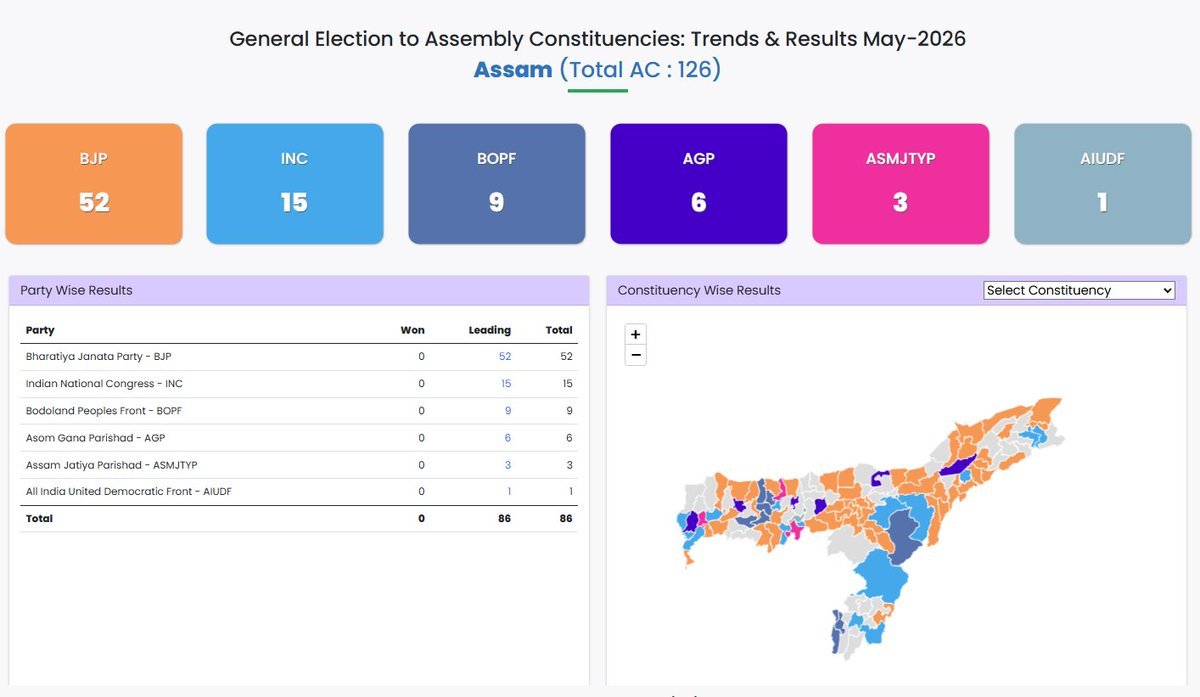
The Assam Assembly seat share has come into focus following post-election analyses of the 126-member Legislative Assembly. The final composition confirms that the National Democratic Alliance (NDA) secured 92 seats, giving the coalition a comfortable majority in the House. The outcome provides the ruling alliance with the legislative strength required to pursue its policy agenda during the Assembly’s tenure.
Supreme Court Order Clears Path for Manipur’s Three-Tier Panchayati Raj Reforms
Mallikarjun Kharge Urges Immediate Release of PM CARES Funds for Flood-Affected Northeast States
NDA Secures Comfortable Majority
The Assam Assembly seat share confirms the NDA’s dominant position in the 126-member House. Consequently, the alliance’s tally of 92 seats places it well above the simple majority mark required to form the government. The result reflects broad electoral support across multiple constituencies in the state.
Meanwhile, opposition parties retained representation in the Assembly and continue to play an important role in legislative debates, policy scrutiny, and holding the government accountable.
The final seat distribution establishes the Assembly’s political balance.
Post-Election Analysis Completed
The Assam Assembly seat share has been finalized through post-election reviews of the official results. Analysts noted that the NDA’s numerical strength provides legislative stability for the government while allowing it to advance budgetary and policy initiatives through the Assembly.
Furthermore, the opposition will continue participating in debates, committee proceedings, and discussions on legislation affecting the state. Parliamentary procedures ensure that all elected representatives contribute to the legislative process.
The analysis offers a clear picture of the House’s composition.
Majority Strength Shapes Governance
The Assam Assembly seat share is expected to influence the government’s legislative priorities and policy implementation. A stable majority enables the ruling alliance to introduce bills, debate financial proposals, and implement development programmes through the constitutional process.
Meanwhile, political observers emphasize that democratic governance also depends on effective legislative scrutiny, informed debate, and constructive participation from both the treasury and opposition benches.
The Assembly remains the state’s principal lawmaking institution.
Conclusion
The Assam Assembly seat share confirms the NDA’s commanding majority with 92 seats in the 126-member Legislative Assembly. The outcome provides the ruling alliance with a stable mandate to govern while preserving the Assembly’s role as the primary forum for legislative debate and accountability. As the House continues its proceedings, both the government and the opposition will contribute to shaping Assam’s policy and development agenda.
FAQs
1. How many seats are there in the Assam Legislative Assembly?
The Assam Legislative Assembly has 126 seats.
2. How many seats did the NDA win?
The National Democratic Alliance (NDA) secured 92 seats.
3. What is the Assam Assembly seat share?
The Assam Assembly seat share refers to the distribution of seats won by political parties and alliances in the 126-member Legislative Assembly.
4. Does 92 seats constitute a majority?
Yes. It is well above the majority mark required to form the government in the 126-member House.
5. What is the role of the opposition after the election?
Opposition parties participate in debates, examine legislation, question the government, and contribute to committee work.
6. Why is seat share important?
It determines the government’s legislative strength and influences the passage of bills, budgets, and public policy.