


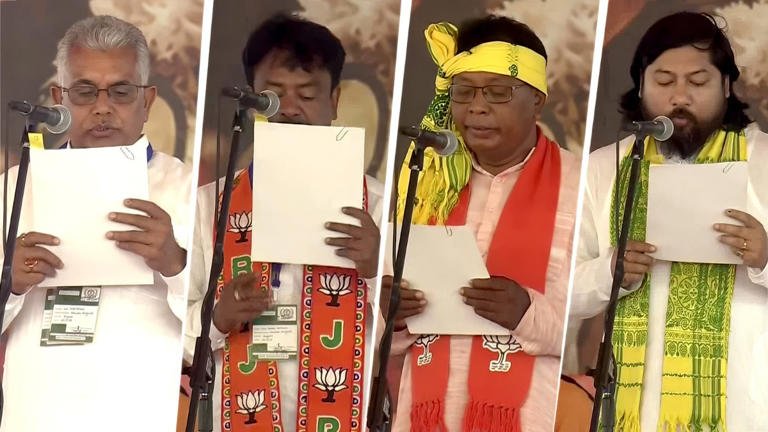
West Bengal witnessed a grand swearing-in ceremony on Saturday after the emphatic electoral victory of the Bharatiya Janata Party in the Assembly elections. The ceremony marked a historic political moment as Suvendu Adhikari took oath as the state’s first BJP chief minister alongside a cabinet designed to reflect caste, community, and regional representation.
RN Ravi administered the oath of office and secrecy to the new chief minister and ministers at the Brigade Parade Grounds in Kolkata. The ceremony witnessed the presence of Narendra Modi, Union ministers, chief ministers from NDA-ruled states, and senior BJP leaders.
Political observers believe the composition of the new cabinet reflects the BJP’s broader social balancing strategy in Bengal. The ministry includes leaders representing OBC, Kayastha, Matua, tribal, and Rajbanshi communities.
Read More: Arunachal CM Seeks Local CUET Centres For Students
BJP Focuses On Social Representation
The BJP appears to have carefully crafted its Bengal cabinet to accommodate multiple social groups and regional identities. Political experts say the move highlights the party’s long-term strategy to strengthen its social coalition in the state.
The inclusion of leaders from different caste and community backgrounds sends a strong political message ahead of future electoral battles. Analysts believe the BJP wants to establish itself as a party capable of representing Bengal’s diverse social structure.
The swearing-in ceremony therefore became more than a formal political event. It also showcased the BJP’s attempt to broaden its acceptance across different sections of society.
With leaders from south Bengal, north Bengal, Junglemahal, and border regions receiving representation, the cabinet reflects a deliberate regional balancing effort.
Suvendu Adhikari Emerges As BJP’s Biggest Bengal Face
Suvendu Adhikari took oath as chief minister after leading the BJP to a historic victory in Bengal. Once considered a close aide of Mamata Banerjee during his time in the Trinamool Congress, Adhikari eventually emerged as the BJP’s strongest political face in the state.
His political rise gained momentum after he defeated Mamata Banerjee twice in her political stronghold. Political observers describe his journey as one of the most dramatic transformations in Bengal politics.
The BJP leadership relied heavily on Adhikari during the Assembly campaign because of his grassroots influence and organisational strength.
Analysts believe his appointment as chief minister symbolises the BJP’s intention to project a strong regional leadership model in Bengal.
Dilip Ghosh Represents OBC Outreach
Senior BJP leader Dilip Ghosh was among the first ministers to take oath during the ceremony. Ghosh won the Kharagpur Assembly seat and entered the Bengal Assembly after playing a major role in the BJP’s organisational growth in the state.
Political observers regard Ghosh as an important OBC face within the BJP in Bengal. His inclusion in the cabinet reflects the party’s continued outreach toward backward communities.
Over the years, Ghosh helped expand the BJP’s grassroots structure across districts where the party previously had limited influence.
Experts say his organisational experience and political visibility make him a significant figure in the new government.
Agnimitra Paul Strengthens Women Representation
Agnimitra Paul also took oath as minister during the ceremony. A second-time BJP MLA from Asansol South, Paul has emerged as one of the BJP’s prominent women leaders in Bengal.
Before entering politics, she worked as a fashion designer and joined the BJP in 2019. She represents the Kayastha community in the new cabinet.
Political analysts believe her inclusion reflects the BJP’s effort to strengthen women’s representation while balancing caste equations.
The party has increasingly focused on women voters and women-centric welfare messaging in Bengal politics.
Paul’s elevation therefore carries both symbolic and political importance within the cabinet structure.
Matua Representation Through Ashok Kirtania
Ashok Kirtania took oath as minister and became one of the key Matua faces in the cabinet.
The Matua community remains politically influential in several districts of Bengal, especially in North 24 Parganas and Nadia. The BJP has consistently focused on Matua voters through citizenship-related issues and refugee welfare concerns.
Political experts believe Kirtania’s inclusion reflects the BJP’s commitment to maintaining strong ties with the Matua community.
The community played a major role in shaping electoral outcomes in several constituencies during the Assembly elections.
Observers say representation in the cabinet may further strengthen the BJP’s support base among Matua voters.
Tribal Outreach Through Kshudiram Tudu
Another important inclusion in the ministry was Kshudiram Tudu, who represents the tribal community.
Tudu won his first Assembly election from Ranibandh and has emerged as a key tribal face of the BJP in Bengal. Professionally, he worked as a government school teacher before entering active politics.
Political analysts say his inclusion reflects the BJP’s continued focus on tribal belts, especially in Junglemahal and western Bengal.
The BJP made significant electoral gains in tribal regions over recent years through sustained grassroots campaigns.
Experts believe tribal representation in the cabinet will help the party strengthen its organisational presence further in these areas.
Rajbanshi Representation Through Nisith Pramanik
Nisith Pramanik took oath as minister after the other leaders during the ceremony.
A former Union minister of state and ex-MP from Cooch Behar, Pramanik began his political career with the Trinamool Congress before joining the BJP in 2019.
He won the Mathabhanga Assembly constituency and is considered one of the BJP’s strongest Rajbanshi leaders in north Bengal.
The Rajbanshi community holds significant political influence in districts such as Cooch Behar and Jalpaiguri.
Political experts believe Pramanik’s inclusion reflects the BJP’s strategy to strengthen its position in north Bengal through regional and community representation.
Regional Balance Visible In Cabinet
The cabinet composition also highlighted regional balancing across Bengal. Leaders from Kharagpur, Asansol, Bongaon Uttar, Ranibandh, and Mathabhanga found representation in the ministry.
Political analysts say the BJP deliberately included leaders from different geographical regions to avoid perceptions of political concentration.
North Bengal, Junglemahal, border districts, and urban regions all received space in the government structure.
Experts believe regional representation often plays a crucial role in maintaining political stability in a socially diverse state like Bengal.
BJP Attempts Long-Term Political Consolidation
The BJP’s first government in Bengal appears focused on converting electoral success into long-term political consolidation. Analysts believe the cabinet structure reflects an effort to build durable support among multiple communities.
The ministry sends a clear message that the BJP wants to create a broad-based political coalition in Bengal.
However, political experts say the government now faces the challenge of meeting expectations across different regions and social groups.
Development, employment, infrastructure, and governance will remain critical factors for the new administration.
For now, the swearing-in ceremony and cabinet formation have marked the beginning of a new political chapter in Bengal, with the BJP attempting to combine governance with carefully calibrated social representation.
Read More: Meghalaya Sets Up Judicial Panel To Probe Garo Hills ADC Poll Nomination Unrest