


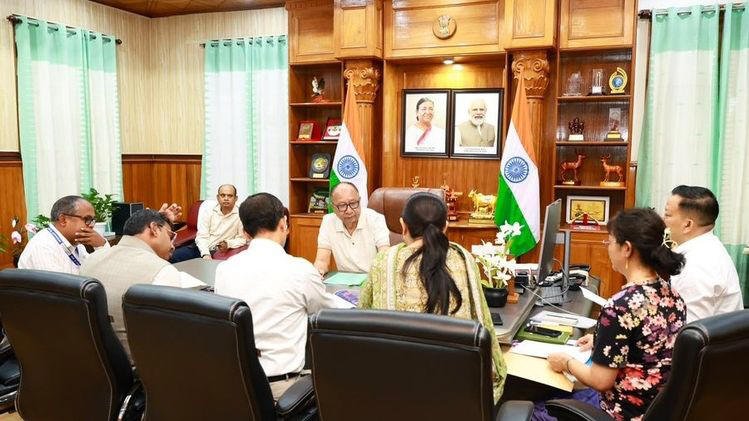
Manipur Chief Minister Yumnam Khemchand Singh reviewed matters related to the Institute of Bioresources and Sustainable Development (IBSD) with officials from the Science & Technology Department.
The meeting took place at the Secretariat and focused on the functioning and development of the institute. Senior officials from several departments also joined the discussion.
The review comes as the state government continues to examine areas linked to science, technology and bioresource development in Manipur.
Read More: Nagaland Upgrades Health and Education Infrastructure Under New Agreement
Senior Officials Attend the Review Meeting
Several senior government officials attended the meeting with the Chief Minister. They included N. Ashok Kumar, Commissioner of Finance, and Dr Rangitabali Waikhom, Special Secretary of Cooperation.
Thokchom Kiran Kumar, Secretary of Information Technology, also attended the meeting. W. Ibohal Singh, Registrar of Cooperatives, was among the other officials present.
Their participation brought together officials from different departments. This helped place IBSD-related matters within the wider administrative and development framework of the state.
IBSD Plays a Key Role in Bioresource Research
The Institute of Bioresources and Sustainable Development operates from Takyelpat in Imphal. It is an autonomous institute under the Department of Biotechnology, Ministry of Science and Technology, Government of India.
IBSD began its activities in Imphal after its establishment in 2001. Its mission focuses on developing bioresources and promoting their sustainable use through biotechnology.
The institute works in the wider ecological setting of the Indo-Burma Biodiversity Hotspot. This makes Manipur and the Northeast important areas for biodiversity research and conservation.
IBSD aims to study the region’s biodiversity and develop scientific methods for its sustainable use. It also works on capacity building, technological development and research collaborations.
Research Covers Important Bioresources
IBSD conducts research across several areas linked to the rich biological resources of Northeast India.
According to the institute, its current research covers plant resources, phytopharmaceutical research, ethnobotany, ethnopharmacology and drug discovery. It also works on microbial resources, fermented food and value addition.
Other research areas include animal resources, eco-restoration, bioenergy and biofuel. The institute also works on freshwater bioresources and aquaculture.
Such research can connect scientific knowledge with local resources and economic opportunities. The institute’s stated objectives include developing technological packages that can support employment and economic growth in the region.
Focus on Sustainable Development
Sustainable use of natural resources remains central to IBSD’s mission. The institute seeks to combine modern biotechnology with conservation and responsible resource management.
Its official mission calls for bioresource development and sustainable use through biotechnological interventions. The institute also aims to strengthen human resources in bioresource conservation and management.
For Manipur, this work has relevance across agriculture, horticulture, medicinal plants, food processing and other bio-based activities. Research can also help identify ways to add value to locally available resources.
The institute’s work therefore connects scientific research with broader development goals. Its activities can support conservation while creating opportunities for technology-based economic activities.
IBSD’s Wider Northeast Presence
IBSD’s work extends beyond its headquarters in Imphal. The institute has expanded its presence to other parts of Northeast India.
Its official information lists centres and research facilities in Shillong, Gangtok and Aizawl. This network allows the institute to work with the diverse biological resources found across the region.
The institute also promotes collaboration with universities, research institutions and other organisations. These partnerships can help strengthen research and improve the application of scientific findings.
IBSD also conducts outreach activities for schools and colleges. These programmes aim to strengthen scientific awareness among younger generations.
Science and Technology as a Development Tool
The Manipur Department of Science & Technology serves as the state’s nodal agency for planning, coordinating and promoting science and technology applications.
According to the department, its work aims to use science and technology for developmental programmes and the socio-economic objectives of the state.
The latest review of IBSD affairs brings the institute’s work into this broader development context. Coordination between government departments and research institutions can help connect scientific research with practical needs.
The presence of officials from Finance, Cooperation and Information Technology also highlights the cross-sector nature of the discussion. Bioresource development can involve research, funding, technology, entrepreneurship and institutional cooperation.
Review Highlights Government Attention to Research
The Chief Minister’s meeting reflects the government’s review of science, technology and bioresource-related matters in Manipur.
The discussion focused on the institute’s functioning and development priorities. However, the available report did not provide details of specific decisions, funding allocations or new projects announced during the meeting.
Further decisions could determine how IBSD’s research and technological capabilities contribute to Manipur’s development. Strong coordination between the state government and scientific institutions could also help translate research into practical applications.
For a state with rich biodiversity, continued attention to scientific research can support both conservation and sustainable economic development. The review therefore places IBSD within Manipur’s wider effort to strengthen science-based approaches to development.
Read More: Sikkim Maps Rain Damage as Landslides and Debris Flows Hit Gangtok