


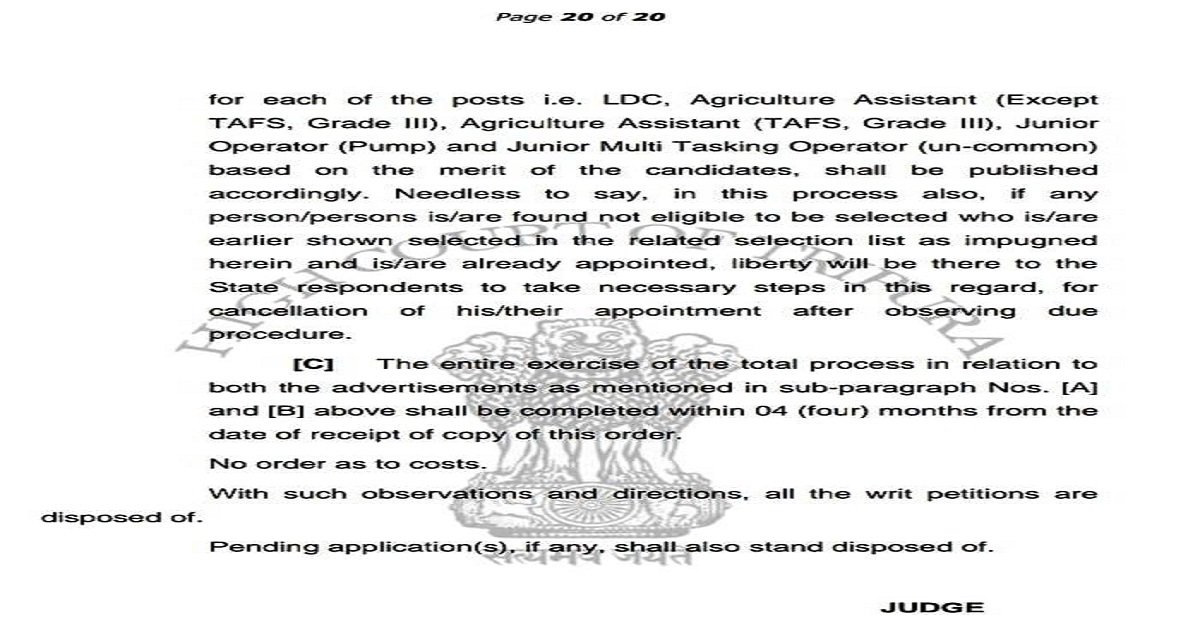
The High Court of Tripura has ordered the Joint Recruitment Board of Tripura to prepare fresh merit-based selection lists for Group-C and Group-D posts within four months. The court found serious flaws in how authorities applied reservation rules for Persons with Benchmark Disabilities (PwBD). As a result, several deserving candidates lost opportunities despite scoring higher marks. The ruling aims to restore fairness and ensure proper implementation of recruitment laws.
Read More: Tripura Rainstorm: MLA Aids Homeless Woman in Mohanpur
Key Facts
- Court: High Court of Tripura
- Judge: S Datta Purkayastha
- Recruiting Body: Joint Recruitment Board of Tripura
- Posts: Group-C and Group-D (MTS, LDC, Agriculture Assistant, others)
- Issue: Incorrect implementation of PwBD reservation
- Petitioners: Joyjit Chowdhury and others
- Timeline: Four months for fresh lists
- Law: Rights of Persons with Disabilities Act, 2016
Recruitment Irregularities Highlighted
The case began when several candidates challenged the recruitment results. They claimed that authorities ignored merit while selecting candidates under the PwBD category. According to them, candidates with lower marks secured jobs, while higher-scoring applicants remained unselected.
The petitioners argued that the recruitment board misapplied reservation rules. Instead of treating disability reservation as horizontal, officials divided it across SC, ST, and UR categories. This approach, they said, violated established legal principles.
During the hearing, lawyers emphasized that authorities must first prepare a merit list based on marks. After that, they should adjust PwBD candidates within their respective social categories.
Court Observations and Legal References
Justice S Datta Purkayastha examined the recruitment process and identified clear errors. He noted that the board failed to follow both Supreme Court rulings and state guidelines.
The court referred to landmark judgments such as Indra Sawhney v. Union of India, Rajesh Kumar Daria v. Rajasthan Public Service Commission, and Rekha Sharma v. Rajasthan High Court. These cases clearly explain that disability reservation works as a horizontal system across categories.
Moreover, the court pointed out that the state’s Office Memorandum dated January 9, 2019, already clarifies this rule. However, the recruitment board did not follow it.
Fresh Merit Lists and New Directions
The court directed the Joint Recruitment Board of Tripura to prepare fresh merit lists strictly based on marks obtained by candidates. After preparing the list, officials must adjust PwBD candidates within UR, SC, and ST categories according to their social status.
The order covers multiple posts, including MTS (Group-D) and Group-C roles such as LDC, Agriculture Assistant, Junior Operator (Pump), and Junior Multi-Tasking Operator.
In addition, the court instructed the state government to calculate disability reservation separately for each cadre and department. Authorities must follow Section 34 of the Rights of Persons with Disabilities Act, 2016 while doing so.
Impact on Existing Appointments
The court clarified that the government can review current appointments. If officials find any candidate ineligible after the revision, they can cancel the appointment. However, they must follow proper legal procedures before taking action.
Finally, the court directed authorities to complete the entire process, including fresh advertisements and publication of revised lists, within four months.
Question–Answer Section
Q1: What did the Tripura High Court decide?
It ordered fresh merit-based lists for JRBT Group-C and Group-D recruitment.
Q2: Why did the court intervene?
Because authorities misapplied disability reservation and ignored merit.
Q3: What error did the recruitment board make?
It treated PwBD reservation as compartmentalized instead of horizontal.
Q4: Will current appointees lose their jobs?
They may lose them if found ineligible after review.
Q5: When will the process be completed?
Authorities must finish it within four months.
Location Context
Tripura, a key state in Northeast India, continues to strengthen transparent governance systems. Therefore, this ruling reinforces fair recruitment practices and protects candidates’ rights.
Also Read: Historic Victory for Assam Temporary Tea Workers on May Day – Prime 24 Seven